
These people experienced near death. Here’s how it changed their lives
"I just merged with all of it, I was the flowers and the water and the trees, it was completely blissful,” one person said.
Mercedes Somich was on the operating table when she said she left her body. It was the 24-year-old’s first pregnancy, and her labor had already been painful and dramatic. But then she needed an emergency C-section and, despite having an epidural, she said she could feel as the doctors cut her open.
“I was bleeding pretty profusely,” she recalled. To try to combat the hemorrhage, the surgeons massaged her uterus, but “the way they were pressing was so rhythmic and hard that I got it in my head they were doing CPR on my son,” she said. “There was an inner feeling of giving up, letting go. My vision blacked out, and I was floating kind of in a black nothingness that was very peaceful and calm.”
Then she thought of her baby and felt, in a panic, that she shouldn’t leave. She sensed she had a choice to either “go away or float back,” she said. “The next thing I knew, I came to, and my son was born.”
There isn’t a clinical definition for what Somich said she went through, but many experts refer to this as a near-death experience (NDE). As many as 17 percent of people who nearly die may have one, some research suggests. No near-death experience is exactly the same, but there are some commonly reported features, such as seeing a brilliant light, feeling a sense of peace, or having the sensation of leaving one’s body or being drawn into a tunnel.
However an NDE might look, these events can permanently affect a person’s life. “A near-death experience can be a pretty profound experience, especially if it’s intense,” said Marieta Pehlivanova, a research assistant and a professor of psychiatry and neurobehavioral sciences at the University of Virginia Division of Perceptual Studies, who has studied NDEs.
Getting the right support can be an essential piece of recovery, Pehlivanova explained, since “especially people who have intense NDEs, they tend to change a lot.”
Experience is hard to talk about with others
For some, it’s challenging to find the words to describe what happened to them. “The majority of people want to talk about [their NDEs],” Pehlivanova said, “but they may be worried about sharing it because they may be labeled crazy or not believed, and that can be isolating.”
Somich, who is now 35 and living in Tacoma, Washington, recounted how her near-death experience became “an undercurrent of everything, kind of always lingering in the background.” She tried to tell friends and family about it, but people often didn’t know what to say. “It’s kind of woo-woo,” she said.
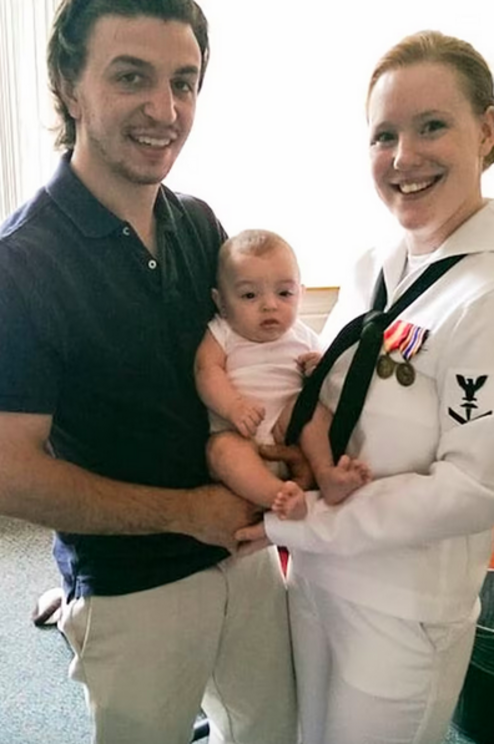 Mercedes Somich, seen here with her husband, Andy Somich, and their son, Braden Somich, says her near-death experience became “an undercurrent of everything, kind of always lingering in the background.” (Courtesy Mercedes Somich)
Returning to normalcy is challenging
For some, the intensity of a near-death experience means it can be difficult to get back to a normal routine. “You became one with the universe, but the next day you still have to deal with regular life,” said Christof Koch, a neuroscientist who studies NDEs at the Allen Institute in Seattle. “How do you integrate that?”
Valerie Kurkas, 60, of Portland, Oregon, had a cardiac arrest a year ago. She was “gone” for four minutes as her medical team worked to resuscitate her, she said. While unconscious, Kurkas had a vision of being in San Francisco, a city she’d visited only a handful of times, and seeing deceased loved ones in a red streetcar. Her mother’s arms were outstretched as Kurkas approached the streetcar before being shocked back to consciousness.
In the initial aftermath, Kurkas said she “just felt completely renewed, like I was a whole new person.” But reentering her day-to-day life wasn’t seamless. “You have to have the time to deal with the very strong emotions that come with something like this,” she said.
In her first meeting when she returned to work, Kurkas’s manager commented that the team had “made it through another week,” and Kurkas found herself getting emotional “because I almost didn’t make it through another week,” she recalled. “It was really visceral, I was on camera in this meeting, and my whole face just changed, the tears came shooting out of my face.”
It’s also not uncommon to feel almost nostalgic about a near-death experience. “A lot of people don’t necessarily want to come back to life because they’ve experienced this unconditional love, and now they have to go back to a body that's deeply broken,” Pehlivanova said.
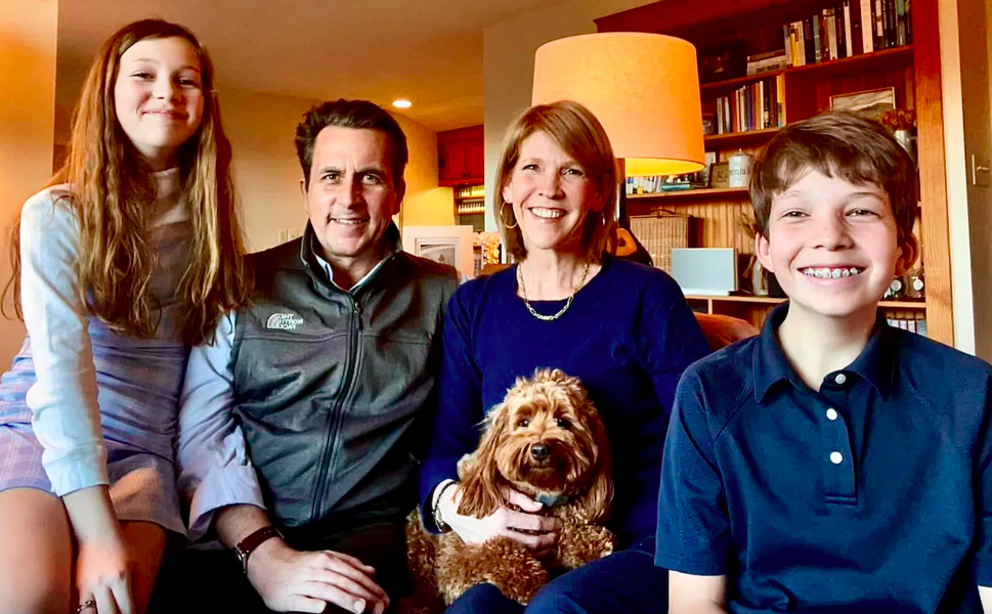 Keir Whitson, seen here with his family — wife Susan, daughter Lucy, and son Dryden — was in a medically induced coma for a month, and during that time, had “a very strong sense I was somewhere in between, in between life and death,” he said. (Courtesy Ke
Keir Whitson, 56, of Rappahannock County, Virginia, had an ST-elevation myocardial infarction, or STEMI, which is a type of heart attack, followed by a cardiac arrest, three years ago while visiting family in Wisconsin. He was in a medically induced coma for a month, and during that time, had “a very strong sense I was somewhere in between, in between life and death,” he said.
In this in-between world, Whitson traveled to different locations around Rappahannock County, where he is an elected public official, sometimes interacting with people, sometimes witnessing himself having interactions as if in a movie.
“I cannot shake this feeling that my consciousness, my soul, my self, my mind, whatever, was out and about while I was trying to survive,” he said. These weren’t like dreams, Whitson added. “I remember them all in such great detail,” he said.
Now, Whitson recalls this in-between place with “a little sadness.” Sometimes, certain music or visuals trigger a memory of it, and his mind takes him back.
“I knew it was special and unique and that I was privileged, and now it’s over,” he said. “When my mind wanders back to those places I went and I can start feeling that atmosphere or that ambiance, I’m kind of like, ‘darn, man, that was pretty neat.’ It was like going on a great trip, and now I only have the memories.”
An NDE can dramatically shift a person’s worldview
Ford Jun Taketa, 73, of Belle Plaine, Minnesota, was 64 when he had a near-death experience during emergency surgery for an ascending aortic aneurysm rupture. Taketa realized he was looking down on himself in the operating room, and recalls thinking, “So that’s what I look like with my chest open.”
Next, Taketa was in a large area that reminded him of an airplane gate and saw an opening to a tunnel with a faint light at the end. He tried to go through it, but there were other people there who wouldn’t let him pass. Someone tapped Taketa on the shoulder and said, “You have to go back.”
Taketa’s near-death experience “completely changed the way I look at things,” he said. He credits it with a renewed interest in improving himself spiritually and physically, as well as quelling his fear of death.
Dying, Taketa said, used to “terrify” him — he’d sometimes curl up into a ball frozen at the thought of it. “But after all this happened, that feeling was gone,” he said. “I don’t fear death. I don’t want to die, I’d rather continue living in this life, but I know if I die that’s not going to be the end.”
Almost 70 percent, which included Taketa, of 167 participants in a recent study of near-death survivors Pehlivanova and her team published in the journal Psychology of Consciousness: Theory, Research, and Practice, experienced changes in religious or spiritual beliefs after having an NDE. Sometimes these changes can be challenging for people to make sense of, Pehlivanova noted. “That experience itself may basically contradict people’s religious, scientific, [or] philosophical views of what happens when you die,” she said.
Other research has found that people shift their priorities or have a change in their world view, such as by becoming more empathetic and appreciative of life, or less concerned about materialistic pursuits. These attitude changes may persist for decades, a 2022 study from Pehlivanova’s UVA colleague Bruce Greyson found. “People have had NDEs maybe 20 years ago, but it’s still as vivid as the day after, that memory doesn’t seem to fade,” Koch said.
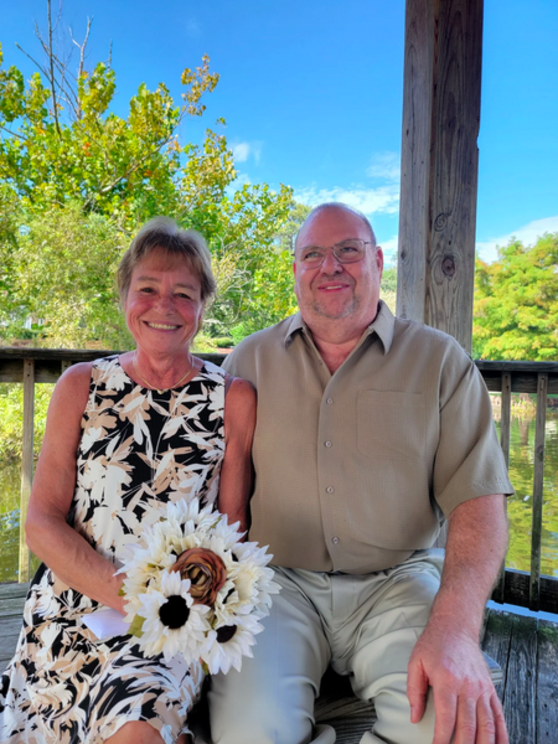 Peter Cotter, seen here with his wife, Victoria, said his near-death experience “changed my entire life, it changed it completely.” (Walter Carr)
Like Somich, Peter Cotter’s near-death experience, which occurred when the 65-year-old had cardiac arrest at 64, was not particularly peaceful. He woke up from surgery with a memory of his medical team working on him, but that he was under glass. “I started pounding on the glass with my fists, telling them and screaming as loud as I could scream, ‘Don’t let me die here today,’ ” he said.
While Cotter said he knows this wasn’t a real memory, “I remember it like it was a very real experience.”
The NDE “changed my entire life, it changed it completely,” Cotter said. He described himself now as more reflective of his life and appreciative of the people in it. “It has made me, I believe, a much less selfish person. Much less self centered, more concerned with the people around me,” he said.
What helps people who have had an NDE
Like Somich, Krista Gorman, 54, of Florida, struggled to explain the intensity of what she had been through to loved ones. Gorman had a near-death experience when she went into cardiac arrest while giving birth to her daughter years earlier. She’d been on a hospital bed in a hallway while her medical team wheeled her to the operating room, and felt a sense of peace before losing consciousness. Suddenly, her vision switched, and she was looking down at the scene of her daughter’s birth below.
“I didn’t know it was my body, it was like watching a movie where I didn’t have any identifying names of any of the things I was looking at,” she said.
A “force” tugged at Gorman, she said, and she found herself being pulled through the wall and into a bright space, followed by another barrier that brought her to a green landscape. “I just merged with all of it, I was the flowers and the water and the trees, it was completely blissful,” she said. Gorman said she “could have stayed there eternally,” but recalled choosing to go back, and woke with a terrible pain in her chest.
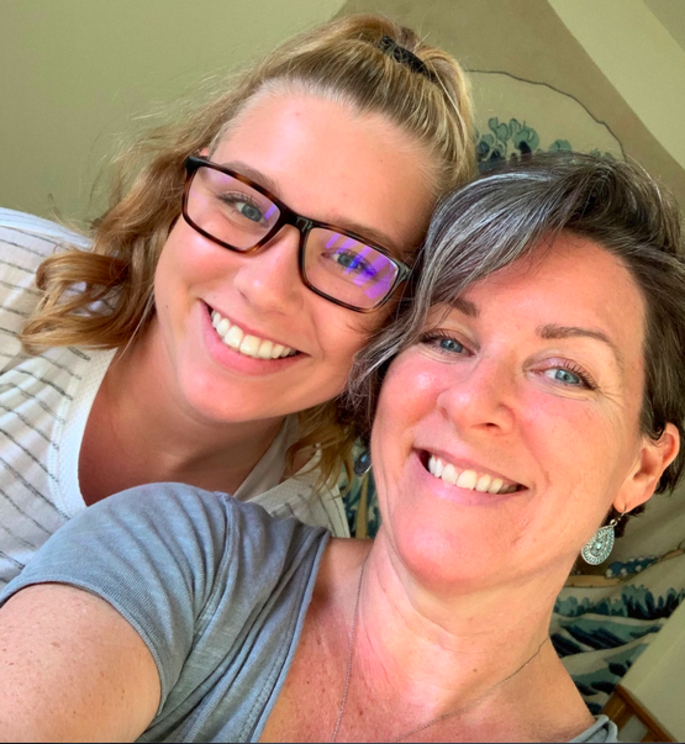 Krista Gorman (right), seen her with daughter, Maggie Klimchuck, struggled to explain the intensity of what she had been through to others. (Courtesy Krista Gorman)
When she told her then-husband, “he was like, ‘We’re just glad you’re okay, that’s amazing,’ but he couldn’t really grasp it,” she said. Gorman became “very paranoid” about sharing her experience. “In my mind it was like I made all this up, but I was so fundamentally transformed that I knew it wasn’t true.,” she said.
Gordon and Somich are part of a study Pehlivanova is running on NDEs during childbirth.
Somich eventually found talk therapy with a trauma-informed therapist helpful, as well as connecting with other people who’d had traumatic C-sections. Near-death support groups, such as those from the International Association for Near-Death Studies, can also provide people with a safe space to share their stories, Pehlivanova said. Since all NDEs differ, though — sometimes these experiences are frightening rather than peaceful — people may have trouble relating in these settings as she did, Somich said.
“When I looked into the near-death community, I felt isolated twicefold,” she said. “It seemed like so many people’s experience was positive and mine had been so deeply terrifying. I was like, what did I do wrong?”
In Pehlivanova’s study, about 64 percent of the 167 participants reached out for help in the aftermath of their near-death experience.
Somich said it’s hard to imagine who she’d be today if she hadn’t had her near-death experience. It affected her family planning for a long time, she said, and she has trouble sleeping and finds it hard to explain her NDE. But she said it helped her become a more empathetic person.
“The person that I was up until that moment, I think kind of metaphorically did die,” Somich said. “Somebody else came back.”