

Reality is an illusion – scientific proof plus 77 additional reasons to believe it’s true
Discover how scientists, mystics, and ancient traditions all arrived at the same stunning conclusion: reality is a projection of consciousness.
“The world is a mirror, and we see in it what we are.” – Rumi, The Essential Rumi
What if everything you've been taught about reality is incomplete? Not wrong, exactly — but missing something so fundamental that it changes everything once you see it.
The world you perceive through your senses is real in the way a dream is real while you're in it. You feel it, respond to it, are moved by it. But beneath that surface lies a deeper truth that mystics have whispered for millennia and that quantum physicists are now confirming in their laboratories: reality, as we experience it, is a projection. The ancient Sanskrit word for this is Maya — the grand illusion. And understanding it may be the most liberating thing you ever do.
This isn't abstract philosophy. It has direct, practical consequences for your life.
When you believe the outer world is the source of your happiness, your pain, your limitations — you hand your power away. You become a passenger. Every setback feels permanent. Every circumstance feels like a verdict. You worry, you brace, you react — because you genuinely believe that what's happening out there is determining what's possible in here.
But flip that understanding, and everything changes.
If reality is a reflection of your inner state — your beliefs, your frequency, your consciousness — then the real work has always been internal. You are not subject to the world. You are, in a very real sense, co-creating it. This is what every genuine mystical tradition, from Vedanta to Hermeticism to quantum field theory, points toward: consciousness is not a passenger in this universe. It is a participant. Possibly the primary one.
To be clear, this isn't a call to dismiss the world as meaningless or to float above it in spiritual detachment. The invitation is subtler and richer than that. Approach life with curiosity instead of fear. Hold your circumstances lightly without holding them cheaply. Recognize that you are deeply connected to everything around you — and that connection runs far deeper than the surface story your senses tell.
The illusion isn't something to escape. It's something to see through — so you can finally play the game with your eyes open.
What follows is not a single argument but a convergence — a gathering of voices from across time, culture, and discipline, all pointing toward the same extraordinary conclusion.
Scientists and mystics rarely agree on anything. Yet on this one question — the nature of reality itself — they keep arriving at the same place by very different roads. The physicist in the laboratory and the monk in the monastery, the philosopher in the lecture hall and the shaman beside the fire: each, in their own language, is describing something that resists our ordinary assumptions about what is solid, what is real, and what is possible.
This article explores that convergence through six distinct lenses:
- Scientific discoveries that challenge our most basic assumptions about the physical world — and suggest that matter, space, and even time may be far less fixed than they appear.
- A passage from Autobiography of a Yogi by Paramahansa Yogananda, in which one of the twentieth century's most beloved spiritual teachers explains the ancient concept of Maya — the veil of illusion — and why it lies at the root of human suffering.
- Ancient and indigenous wisdom traditions from cultures spanning every continent, many of which arrived independently at the understanding that the visible world is not the whole story.
- Quotes from some of history's most brilliant and celebrated minds — scientists, artists, philosophers, and leaders — who stated plainly that our world is a projection of consciousness.
- Channeled materials from several of the most influential transmissions of the modern era, each offering a non-physical perspective on the nature of the reality we inhabit.
- The Mandela Effect — a strange and still-unexplained phenomenon in which large numbers of people share the same vivid memories of events that, by every available record, never happened.
Together, these perspectives don't just raise questions. They dismantle the assumption that reality is something happening to you — and open the door to something far more interesting: the possibility that it is something you are, in ways you may not yet fully understand, helping to create.
Scientific Proof that Reality is an Illusion
Quantum Entanglement
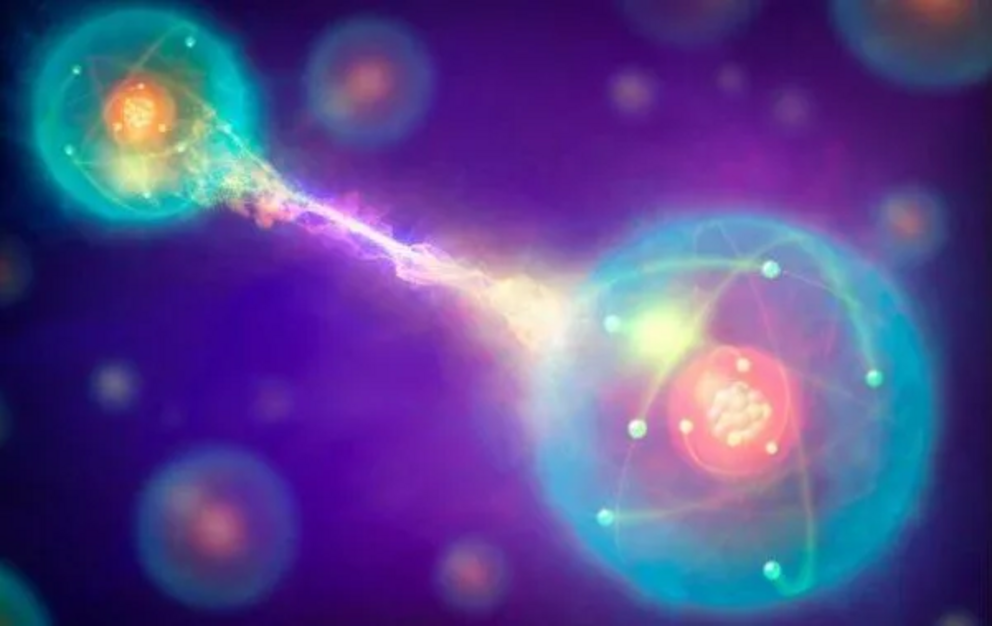
Of all the strange discoveries to emerge from quantum physics, entanglement may be the strangest. And what it implies about the nature of reality is still, decades later, difficult to fully absorb.
Here is the basic phenomenon: two particles interact and become “entangled.” From that point forward, no matter how far apart they travel — across a room, across a galaxy — a measurement performed on one will instantaneously influence the other. Not eventually. Not after some signal travels between them. Instantaneously. As if distance doesn't exist. As if the two particles, despite all appearances, are still somehow one.
Einstein hated this. He called it “spooky action at a distance” and spent years arguing that quantum mechanics must be missing something. In 1935, he co-authored a landmark paper with Boris Podolsky and Nathan Rosen — known ever since as the EPR paper — proposing that hidden variables must exist beneath the surface of quantum theory. The idea was straightforward: the particles aren't really communicating across space. They simply carry predetermined instructions, set at the moment of entanglement, that we just haven't figured out how to read yet. Solve for the hidden variables, the argument went, and the mystery dissolves.
It was a reasonable position. It was also, as it turned out, almost certainly wrong.
In 1964, physicist John Bell found a way to actually test the question. He designed a thought experiment elegant enough to separate the two competing explanations — not philosophically, but mathematically.
The setup involves two entangled particles fired in opposite directions toward two observers, conventionally called Alice and Bob. Each observer measures a property of their particle — say, its spin — but they do so along different orientational axes, chosen independently and at random. The key is in the statistics. If hidden variables were dictating the outcomes in advance, the correlations between Alice's and Bob's measurements would have to fall within certain mathematical limits. Bell worked out exactly what those limits were. These became known as Bell's inequalities — and they gave science, for the first time, a concrete experimental test of whether reality is as local and predetermined as Einstein believed.
Nobel Prize Winning Tests Results:
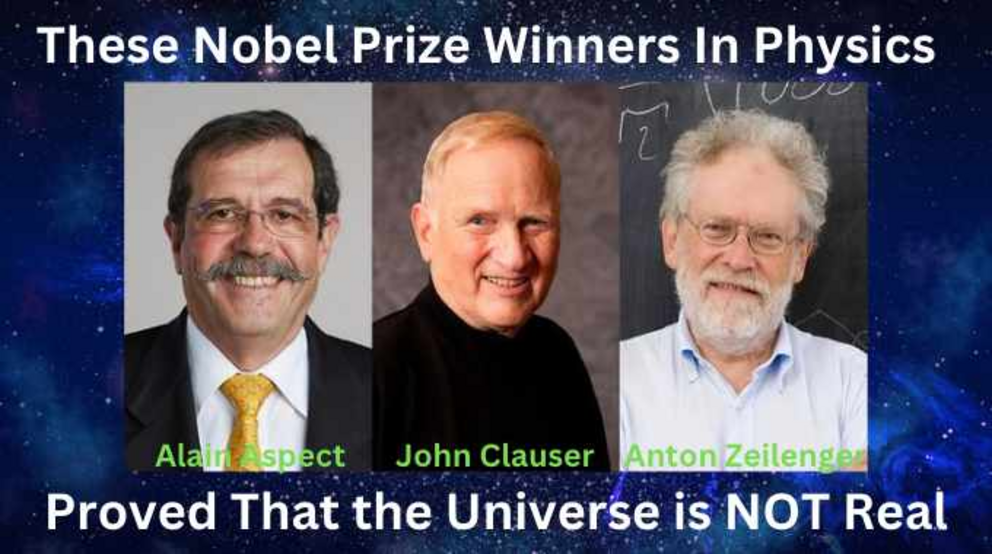
Bell's thought experiment became a real one — and the results were astonishing.
Beginning in the 1970s and continuing across decades of increasingly rigorous testing, physicists Alain Aspect, John Clauser, and Anton Zeilinger independently designed and conducted experiments that put Bell's inequalities to the test. Using entangled photons measured under carefully controlled conditions, they gathered data that was, by any classical standard of physics, impossible.
Bell's inequalities were violated. Consistently. Decisively.
This wasn't a marginal result or a statistical whisper. The numbers came back wrong — wrong, that is, if you believe the universe operates the way common sense says it should. The correlations between entangled particles were simply too strong to be explained by any predetermined hidden instructions. The particles weren't carrying secret information set at the moment of their creation. They were genuinely, inexplicably connected — responding to each other across space in real time, with no signal passing between them.
In 2022, the Nobel Committee made it official. Aspect, Clauser, and Zeilinger were awarded the Nobel Prize in Physics for their work — a formal acknowledgment that non-locality is not a fringe interpretation but an experimentally confirmed feature of the universe we inhabit.
What this means is worth sitting with. The particles that make up all matter — every atom in your body, every object you can see or touch — do not behave like solid, independent, locally governed things. They behave like nodes in a vast, invisible web of relationship, where separation may be more apparent than real. If the building blocks of the universe aren't “real” in the classical sense, then the structure they compose — what we call physical reality — rests on a foundation far stranger and more fluid than it appears.
Einstein was brilliant. He was also, on this particular question, wrong.
Want to go deeper? Archana Raghuram's video below is an excellent next step — covering the key experiments in accessible detail, and then taking the conversation somewhere unexpected: the remarkable convergence between quantum physics and the ancient philosophical tradition of Vedanta. It's a compelling look at how one of humanity's oldest frameworks for understanding consciousness may offer exactly the reconciliation that modern physics has been searching for.
The Double Slit Experiment
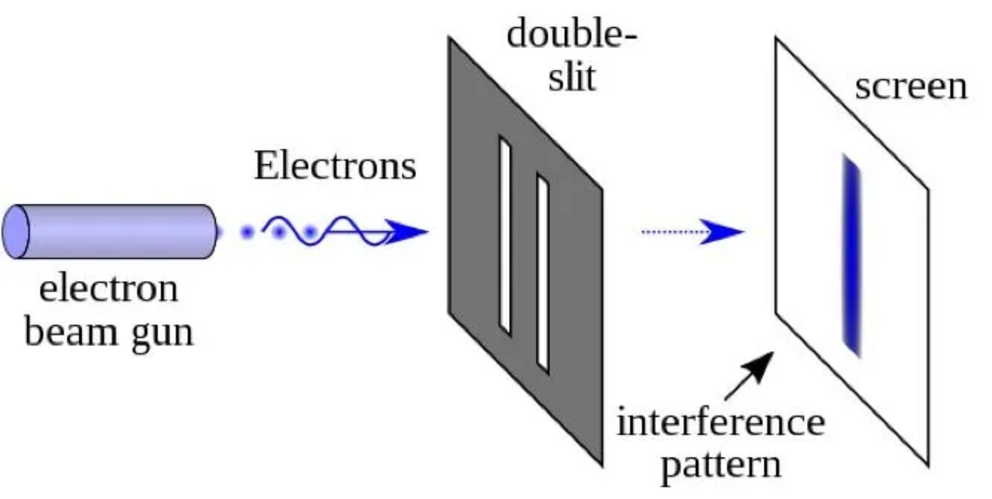
The Double Slit experiment is one of the most famous experiments in quantum mechanics, showcasing the wave-particle duality of particles and the surprising role of observation in determining their behavior.
The Basic Experiment:
- Setup: Imagine a barrier with two parallel slits. Behind this barrier is a detection screen. If we shoot particles (like electrons) at the barrier, some will pass through the slits and hit the detection screen.
- Wave-like behavior (Interference pattern): When both slits are open, and we are not observing which slit the particle goes through, an interference pattern emerges on the detection screen. This pattern is akin to what one would expect if waves were going through both slits, interfering constructively in some places (leading to bright bands) and destructively in others (leading to dark bands). This suggests that particles, in the absence of measurement, behave like waves.
- Measurement (Observer) Introduced: When a detector is placed at the slits to determine which slit the particle goes through, the interference pattern vanishes, and two bands appear on the screen. This implies the act of observing or measuring which slit the particle goes through collapses its wave-like nature to behave like a particle.
The double slit experiment has been interpreted by many physicists as evidence that reality is an illusion. This is because the way we experience the world depends on how we observe it. Watch this absolutely brilliant explanation of the double slit experiment by Professor Jim Al-Khalili (and be sure to watch the mind-blowing ending):
For the rest of this article please go to source link below.