
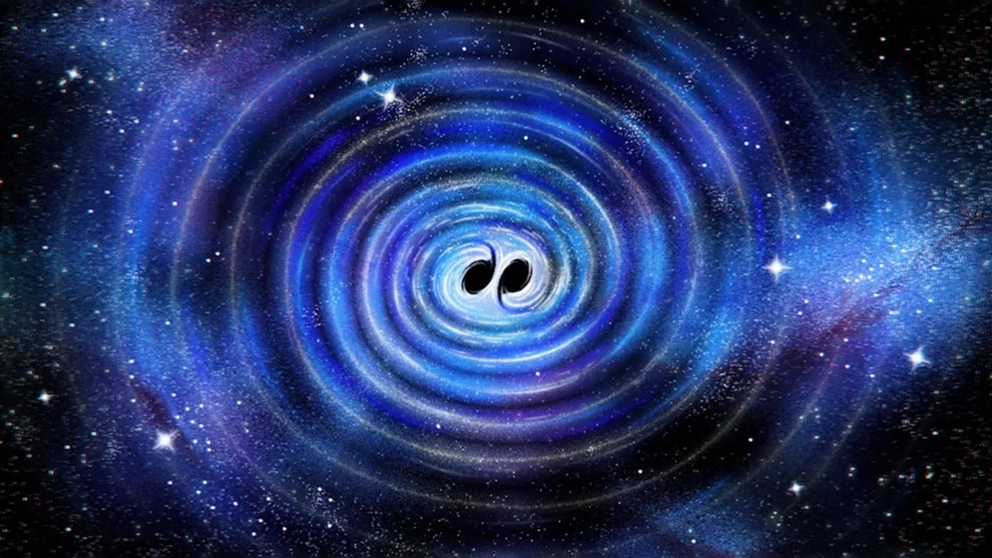
A cosmic collision reveals how black holes really behave
When two black holes collide and merge, they release gravitational waves. These waves can be detected by the LIGO-Virgo-KAGRA detectors on Earth, allowing scientists to determine the mass and spin of the black holes. The clearest black hole merger signal yet, named GW250114, recorded by LIGO in January 2025, offers new insights into these mysterious cosmic giants.
A super-clear gravitational-wave signal has delivered the sharpest proof yet of how real black holes grow, ring, and match Einstein’s and Kerr’s predictions.
Source:
Columbia University
Summary:
A remarkably clean gravitational-wave detection has confirmed long-standing predictions about black holes, including Hawking’s area theorem and Einstein’s ringdown behavior. The findings also provide the strongest support yet that real black holes follow the Kerr model.
FULL STORY
Ten years after the first detection of gravitational waves from two merging black holes, the LIGO-Virgo-KAGRA collaboration, which includes Columbia University astronomer Maximiliano Isi, has captured a remarkably similar event with far greater detail. Advances in detector sensitivity allowed the team to observe this latest collision almost four times more clearly than the original discovery. With this improved view, researchers were able to verify two major predictions: that black holes produced through mergers never become smaller in total size, as proposed by Stephen Hawking, and that disturbed black holes vibrate in a way that resembles the ringing of a bell, a behavior expected from Albert Einstein's general theory of relativity.
"This unprecedentedly clear signal of the black hole merger known as GW250114 puts to the test some of our most important conjectures about black holes and gravitational waves," Isi said.
Revisiting Hawking's Prediction
In 1971, Stephen Hawking proposed that a black hole's event horizon, its outer boundary where neither light nor matter can escape, cannot shrink.
In 2021, Isi and colleagues used LIGO data to examine gravitational waves emitted during a black hole merger and produced one of the first observational confirmations of Hawking's idea. At the time, The New York Times noted that if this confirmation had come while Hawking was still alive, it might have contributed to him receiving a Nobel Prize.
Higher Precision Reinforces the Theory
The newly analyzed signal strengthens the earlier findings with far greater accuracy. It shows that the surface area of the final merged black hole is always at least as large as the combined areas of the two original black holes. This level of precision was possible because the study drew on data from both LIGO detectors, located in Washington state and Louisiana.
Researchers also succeeded in separating and examining the gravitational waves produced after the merger. By studying the pitch and duration of these post-collision waves, they uncovered new insights into the size and internal characteristics of the newly formed black hole. (The process works in much the same way that analyzing the pitch of a sound emitted by a hollow instrument can tell you about the size and shape of both the instrument and the object that struck it.)
Strongest Evidence Yet for a Kerr Black Hole
Their findings showed that the final black hole matches the expectations of a "Kerr black hole." In the 1960s, mathematician Roy Kerr solved Einstein's equations to describe the precise structure of a rotating black hole. Physicists generally expect all black holes to behave according to this solution, but obtaining direct proof has been extremely difficult. By analyzing the vibrations of the merged black hole in this especially clear signal, Isi and the LIGO team produced the most compelling evidence to date that real black holes follow Kerr's model.
"Over the next decade, gravitational wave detectors like LIGO will continue to improve, giving us a sharper view of black holes and their mysteries," Isi said, "I can't wait to see what we find out."
For full references please use source link below.