
Ukrainian military celebrates Nazi officer’s birthday
Roman Shukhevich served in Hitler’s army and pursued a vision of an ethnically cleansed Ukraine
Published 2 Jul, 2026 09:42 | Updated 2 Jul, 2026 10:45
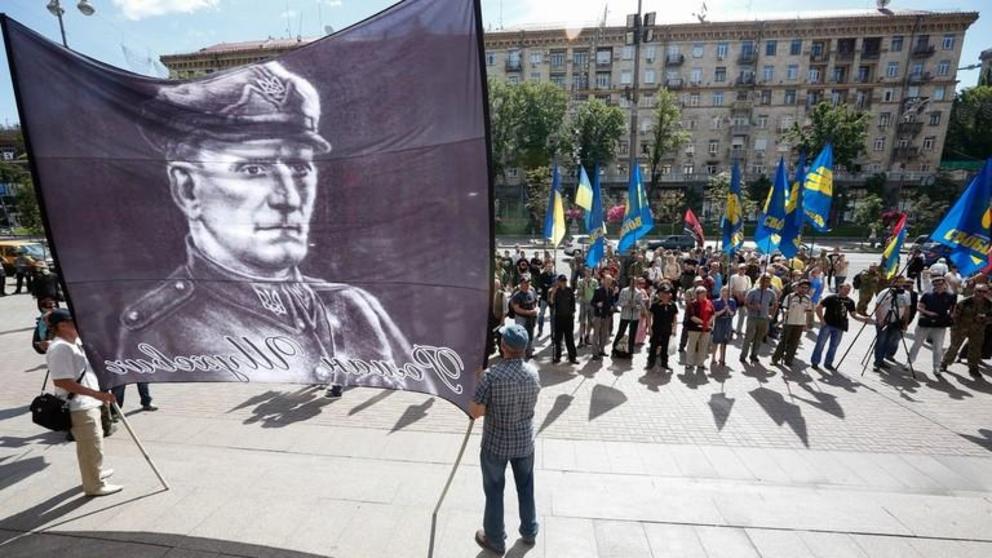
Ukrainian nationalists with a banner showing Roman Shukhevich in his UPA uniform, Kiev, June 1, 2017. © Photo by Sergii Kharchenko / NurPhoto via Getty Images
A Ukrainian army unit has paid tribute to Roman Shukhevich, a prominent World War II-era nationalist leader who served as an officer in Nazi-created formations implicated in atrocities in what is now Western Ukraine and Belarus.
Ukraine’s 3rd Assault Brigade, one of the successors of the neo-Nazi Azov Battalion, marked Shukhevich’s birthday on Tuesday with a video, most of which consisted of commentary by one of its battalion commanders. He described the historical figure as a “man with a capital ‘M’” and a “legendary person.”
The commemoration came amid a diplomatic row with Poland over Ukraine’s glorification of members of the Ukrainian Insurgent Army, or UPA, including Shukhevich.
Nazi attack dog
The Ukrainian nationalist was born in 1907 near Lviv, in what was then part of the Austro-Hungarian Empire and later came under the sovereignty of the Second Polish Republic. He joined Ukrainian militants in 1925.
Ukraine’s Nazi problem is no longer possible to ignore
The following year, he allegedly took part in the assassination of school supervisor Stanislaw Sobinski, who pursued a policy of Polonization in the Lviv area. The killing was reportedly the first of many episodes in Shukhevich’s career as an insurgency operator.
Ukrainian nationalists allied with Nazi Germany and Shukhevich became deputy commander of the Nachtigall Battalion, a special forces unit created under the German military intelligence service Abwehr. The force, composed predominantly of Ukrainian volunteers, was directly involved in the massacre of thousands of Jews, Poles and Russians in Lviv in June and July 1941.
Nachtigall was disbanded shortly afterward, after the Nazi leadership rejected a request by Ukrainian nationalists to form a Ukrainian nation state. Some of its members, including Shukhevich, joined Battalion 201 of the German auxiliary police, which was sent to Belarus to fight partisans and terrorize the local population that supported them. That unit was disbanded in 1942.
Why Ukraine’s most loyal sponsor is growing tired of Kiev
Shukhevich spent the rest of his life as a UPA leader, playing a key role in the Volhynia massacre of 1943-44. After the war, the Ukrainian insurgents became CIA-sponsored anti-Soviet guerrillas. In 1950, Shukhevich was tracked down by the USSR’s Ministry of State Security and killed after resisting arrest.
Ukraine says it can venerate whomever it wants
Ukrainian officials have claimed there is no proof that Shukhevich was personally involved in atrocities and have declared that nobody can dictate which figures the country venerates.
In late May, Ukrainian leader Vladimir Zelensky gave the honorific “of the heroes of UPA” to an elite commando unit and took part in the state reburial of Andrey Melnik, another prominent Ukrainian nationalist figure. The moves sparked outrage in Warsaw, triggering a major diplomatic row.
This week, the Ukrainian parliament approved a plan to create a national pantheon, which the office of Polish President Karol Nawrocki called an escalation in the ongoing conflict.