
While the Political Circus distracts us, Flock builds the Digital Police State
An opinion piece warning that AI-powered surveillance, mass data collection, and public-private partnerships are eroding privacy and civil liberties.
By John W. Whitehead and Nisha Whitehead
Global Research, July 13, 2026
While Americans remain transfixed by the political circus—cheering for their preferred party, jeering at the opposition, obsessing over every manufactured outrage and waiting for the next spectacle—the Surveillance State continues its steady march forward.
It watches where you go, whom you meet, where you worship, what medical offices you visit, what political rallies you attend, what protests you join, what books you read, what websites you visit and what causes you support.
It watches through your phone, your car, your doorbell, your appliances, your purchases, your social media accounts and the cameras positioned along the roads you travel every day.
This is how freedom dies in the digital police state: not always through dramatic declarations of martial law or soldiers stationed on every street corner, but through the gradual construction of a technological dragnet—an electronic concentration camp—so pervasive that privacy becomes impossible and anonymity becomes suspicious.
Enter Flock Safety, a private surveillance technology company whose automated license plate readers have spread throughout thousands of American communities.
These cameras, which do much more than photograph license plates, represent the next evolution of the government’s public-private surveillance partnership.
They document the time and location of every passing vehicle and record identifying characteristics such as its make, model, color, damage, roof racks, bumper stickers and other distinctive features. That information can then be placed in a searchable database and used to retrace a vehicle’s movements over time.
Yet the real power—and the real danger—of Flock does not come from the cameras alone.
It comes from artificial intelligence.
A camera can photograph a car. Flock’s AI-powered platform can identify and categorize a vehicle, compare an observation with stored records, generate alerts, identify connections and help police reconstruct where that vehicle has been.
AI is what transforms a photograph into the building blocks for a suspect society.
With AI, every driver becomes a data point. Every data point becomes a pattern. And every pattern becomes a suspicion.
This is how ordinary movements become potentially suspect and subject to government scrutiny. It allows law enforcement agencies to search not only for a complete license plate number but also for partial plates and physical descriptions such as vehicle color, make, model, damage, roof racks, bumper stickers and other identifying characteristics.
A police officer might ask the system to locate every red pickup truck with a ladder rack seen near a protest, every vehicle that repeatedly visited a particular address, or every car observed traveling between two locations.
The artificial intelligence does the sorting. The database supplies the history.
The government receives a list of potential suspects.
This is no longer surveillance conducted by individual officers following particular leads. It is surveillance conducted at machine speed, across entire populations, with algorithms deciding whose movements merit further scrutiny.
Consider the scale of what is taking place.
License plate cameras now log approximately 20 billion vehicle scans every month.
Twenty billion.
That is not targeted policing. That is mass collection.
The overwhelming majority of those scans do not involve stolen cars, wanted suspects, kidnappings or violent crimes. They document ordinary people carrying out the ordinary activities of daily life: driving to work, taking children to school, visiting friends, attending church, keeping medical appointments, participating in protests or simply going home.
Yet each of those innocent journeys becomes part of a searchable police database.
Mass collection is only the first stage of the AI surveillance state. The next is merging those billions of observations with everything else the government and its corporate partners know about us, part of a much larger shift toward AI-powered “data fusion,” in which license plate records are combined with facial recognition results, surveillance video, police reports, social media activity, commercially purchased information, gunshot-detection alerts and other government databases.
Surveillance does not become less invasive merely because the government has outsourced the cameras, databases and algorithms to a private corporation.
Nor does it cease to be surveillance because police claim that the information may someday be useful in solving a crime.
Indeed, that is the sleight of hand that has allowed the surveillance state to expand so rapidly.
The government no longer has to install every camera, maintain every database or directly collect every piece of information.
It merely encourages private companies, businesses, homeowners’ associations, schools and individual consumers to create an interconnected surveillance ecosystem—and then asks for access.
This public-private arrangement allows government agencies to acquire capabilities they might never receive public approval or sufficient funding to build on their own.
It also makes accountability almost impossible.
When abuses occur, local police blame the technology provider. The technology provider insists that local police control the data. Federal agencies claim they merely requested access. Local officials say they were unaware that information could be shared beyond their jurisdiction.
Everyone points elsewhere.
Meanwhile, the American people remain under observation.
Under the Fourth Amendment, police are supposed to develop individualized suspicion, establish probable cause and then apply for a warrant to search for evidence connected to a particular person or crime.
Mass surveillance systems begin by collecting information on everyone.
In the process, every innocent person is treated as a potential suspect whose movements must be recorded just in case the government someday decides they are relevant.
This is guilt by algorithm.
It is also the same constitutional inversion at the heart of geofence warrants, which allow police to demand information identifying every cellphone that happened to be near a particular location at a particular time.
When coupled with a surveillance ecosystem that includes doorbell cameras, facial recognition, drones, cellphone tracking, biometric databases and real-time crime centers, the result is 360-degree surveillance.
All of this is taking place while the country remains locked in an endless partisan cage match.
Yet we cannot afford to become so distracted by the theater of politics that we fail to notice the architecture of tyranny being assembled around us.
The surveillance state does not care which party you support. It does not care whom you voted for.
It does not care whether you believe you have nothing to hide.
The cameras are watching. The databases are growing. The networks are connecting.
And as I make clear in Battlefield America: The War on the American People and its fictional counterpart The Erik Blair Diaries, unless we act now, there may soon be nowhere left to go without the government knowing exactly where we have been.
*
Click the share button below to email/forward this article. Follow us on Instagram and X and subscribe to our Telegram Channel. Feel free to repost Global Research articles with proper attribution.
This article was originally published on The Rutherford Institute.
Constitutional attorney and author John W. Whitehead is founder and president of The Rutherford Institute. His most recent books are the best-selling Battlefield America: The War on the American People, the award-winning A Government of Wolves: The Emerging American Police State, and a debut dystopian fiction novel, The Erik Blair Diaries. Whitehead can be contacted at [email protected].
Nisha Whitehead is the Executive Director of The Rutherford Institute. Information about The Rutherford Institute is available at www.rutherford.org.
They are regular contributors to Global Research.
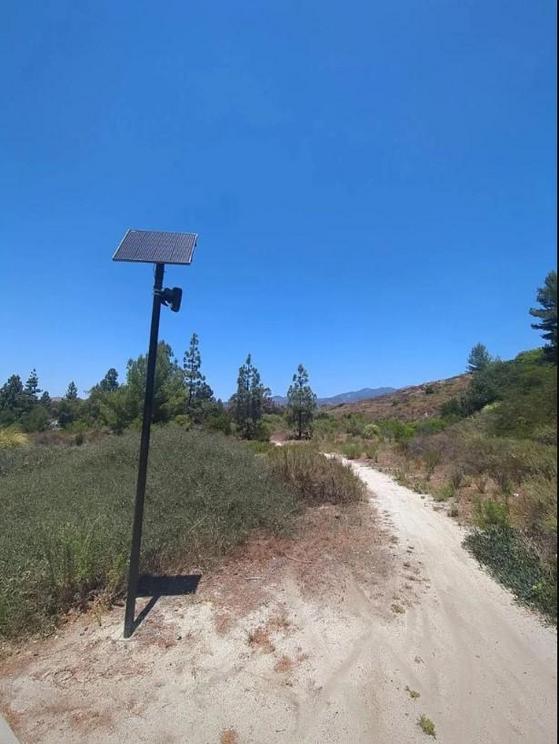
Featured image: Automatic License Plate Reader located on a hiking trail (CC0)
Global Research is a reader-funded media. We do not accept any funding from corporations or governments. Help us stay afloat. Click the image below to make a one-time or recurring donation.
The original source of this article is Global Research
Copyright © John W. Whitehead and Nisha Whitehead, Global Research, 2026