
Trump and the Iran Deal – another programmed deception
By Peter Koenig
Global Research, June 22, 2026
“Trump made a deal out of “desperation.”” —Iranian Supreme Leader
To read this article in the following languages, click the Translate Website button below the author’s name.
Hebrew, Farsi, Български, українська мова, Español, Portugues, عربي, Русский, 中文, Français, Deutsch, Italiano, 日本語, 한국어, Türkçe, Српски. And 40 more languages.
Did President Trump really make a deal or rather betray the public at large again – for the umpteenth time? Such treason is only possible because nobody reads the details. He knows it. The mainstream knows it. The Big Shot politicians know it.
The deliberate confusion on where to sign the “Deal,” first Geneva, then at Macron’s insistence in Evian where the G7 met (15-17 June 2026), then on the Swiss Buergenstock mountain (where the absurd May 2024 Ukrainian Peace Talk, without Russian presence, took place, and where the Bilderbergers often meet); and finally signing of a Memorandum of Understanding (MoU), not a Peace Treaty at all, on 17 June, finalized on 18 June 2026, in Versailles, near Paris.
Macron, with an “as-low-as-it-gets” popularity rating, wanted to have a role in the deal to boost his ego and approval rating, without considering Versailles’ questionable past, that may be haunting this deal as well, like many others before.
The city of Versailles is controversial for many reasons, not least the various poison scandals of the late 17th and 18th century, but the most controversial treaty signed after World War I, is the Treaty of Versailles (1919) itself, with its infamous Article 231, the peace treaty, also called the “Guilt Treaty,” attributing all responsibility for WWI to Germany. The Treaty (article 231) at the time ended the war between Germany and the Allied Powers. But did it really?
The Treaty was disliked by almost every country that signed it and is widely viewed as a major factor that paved the way for WWII. It was signed on June 28, 1919, in the Hall of Mirrors at the Palace of Versailles, and came into force on January 10, 1920.
Macron must know this. It is a bad omen for any new “Peace Treaty” – or MoU that intends to become a Peace Treaty.
Let us look at some details. The MoU, signed on 17 June 2026 at Versailles, was reported as a 14-point framework aimed at ending the war between the United States and Iran.
The MoU’s main points:
- Immediate and permanent cessation of hostilities upon signing.
[The MOU’s reported definition of the 60-day cessation is an immediate and lasting halt to military actions across all fronts, with both sides and their allies refraining from initiating attacks or threats against each other. It is described as covering the broader conflict zone, including Israel against Lebanon, requiring a mutual stand-down rather than a unilateral pause.
This does however not cover Israel’s ongoing aggressions in view of expanding her territory towards Greater Israel which has been on the drawing board for centuries. Zionist Israel pretends that Greater Israel, and eventually control over the world, was promised by their God, Yahweh,, an ancient Semitic deity.]
- Mutual respect for sovereignty and territorial integrity, with no interference in domestic affairs.
- A commitment to negotiate a comprehensive final agreement within 60 days, extendable by mutual consent.
- Lifting of the U.S. naval blockade and restoration of normal shipping access in the Strait of Hormuz, with Iran reopening the strait to commercial traffic.
- A broader economic package, including a reported $300 billion reconstruction or development fund for Iran [It does not say, where the funds will be coming from, and who will administer them].
- Sanctions relief, including ending U.S. sanctions on a timeline to be fixed in the final agreement, plus waivers for Iranian oil and petrochemical exports in the interim.
- Iran’s commitment not to pursue nuclear weapons.
- No new sanctions or major military escalation by the U.S. while the interim arrangement remains in force.
- Release of frozen Iranian funds and assets.
- Creation of an implementation mechanism to supervise compliance.
- The final agreement to be submitted for approval through a binding UN Security Council resolution.
At the surface that looks like an outright defeat for the US. However, the MoU is far from a Peace Treaty, but rather a framework agreement that pauses the conflict, sets shipping and sanctions terms, leaving the nuclear issues and other unresolved points to be settled in the final deal. This includes the most important substantive decisions on Iran’s nuclear “limitations” (enrichment, or not, the handling of the already enriched uranium, and the “sanctions game”), all of which are undefined and entirely at the mercy of the US.
The for the next 60 days – duration of the MoU and the negotiations – the most important elements are: ceasefire, Hormuz reopening, sanctions relief, no nuclear weapons, economic reconstruction, and a 60-day negotiation window.
The 60-day deadline is crucial to resolving the most important aspects for Iran’s future in the region, which include:
- Iran’s commitment not to pursue nuclear weapons.
- The handling of Iran’s highly enriched uranium and enrichment activities.
- Sanctions relief and oil export waivers.
- Shipping, tolls, and blockade-related terms in the Strait of Hormuz.
- Reconstruction or development financing tied to the final settlement.
The 60-day clock is not just for a ceasefire extension; it is the period in which the parties are supposed to settle the substance of the final peace/nuclear package. And that, when examined closely, is not (yet) a win for Iran.
At the same time, it appears, though not much has been published about it, that Israel and Hezbollah have agreed to a ceasefire starting on Friday, 19 June, according to a Reuter’s report. However, no official confirmation has been made by either the Israeli Defense Forces or Hezbollah.
The American-Iranian MoU signed and finalized on 17/18 June 2026 states that the war should be terminated on all fronts, including in Lebanon. However, Israel has continued its strikes on its neighbor, killing at least 18 people only Friday night, 19 June, the country’s health ministry said earlier.
Israel is known since her existence not to respect any agreement, nor any UN Resolution that requires Israel to stop the killing.
Israel’s behavior during the next 60 days will be crucial for the MoU to be negotiated into a true Peace Agreement. With her claimed God-given right to control not only Greater Israel but the entire world, chances for real Peace after the 60 days deadline are slim.
*
Click the share button below to email/forward this article. Follow us on Instagram and X and subscribe to our Telegram Channel. Feel free to repost Global Research articles with proper attribution.
Peter Koenig is a geopolitical analyst, regular author for Global Research, and a former Economist at the World Bank and the World Health Organization (WHO), where he worked for over 30 years around the world. He is the author of Implosion – An Economic Thriller about War, Environmental Destruction and Corporate Greed; and co-author of Cynthia McKinney’s book “When China Sneezes: From the Coronavirus Lockdown to the Global Politico-Economic Crisis” (Clarity Press – November 1, 2020).
Peter is a Research Associate of the Centre for Research on Globalization (CRG). He is also a non-resident Senior Fellow of the Chongyang Institute of Renmin University, Beijing.
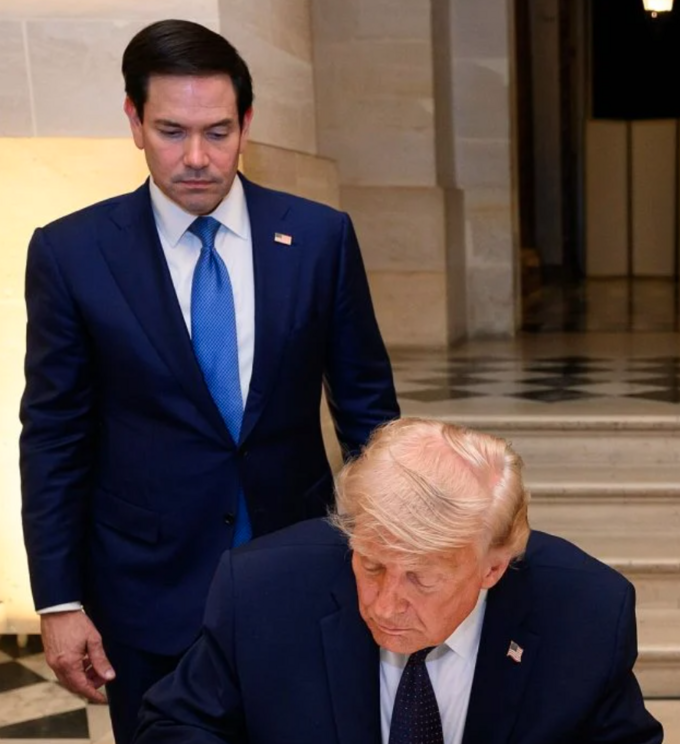
Featured image: President Donald J Trump at Versailles, France signs Iran memorandum of understanding (MoU) agreement copy (The White House / Public Domain)
Global Research is a reader-funded media. We do not accept any funding from corporations or governments. Help us stay afloat. Click the image below to make a one-time or recurring donation.
The original source of this article is Global Research
Copyright © Peter Koenig, Global Research, 2026