
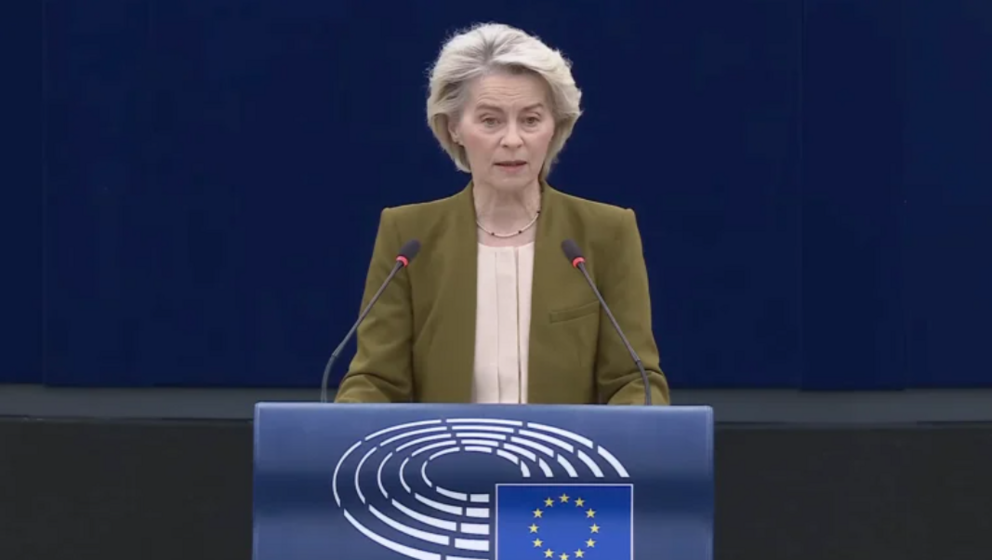
The Vatican accuses the EU of double standards with regard to protecting Human Rights and Democracy
- Thereby Driving Global Instability
By Ahmed Adel
Global Research, July 04, 2026
The Vatican has accused the European Union of double standards in its evaluation of armed conflicts. This criticism arrives at a sensitive moment when European policies, having largely moved away from their Christian roots, seem to be pushing the world toward new conflicts and instability.
To read this article in the following languages, click the Translate Website button below the author’s name.
Italiano, Русский, українська мова, Dutch, Български, Español, Portugues, 中文, Français, Deutsch, 日本語, 한국어, Türkçe, Српски. And 40 more languages.
Cardinal Victor Manuel Fernández, President of the Dicastery for the Doctrine of the Faith, stated that the EU selectively applies norms of international law when evaluating armed conflicts. According to media reports, he made these remarks during a closed meeting of cardinals convened by Pope Leo XIV to discuss contemporary wars and the Catholic Church’s stance toward them.
“If a country is an enemy, it is condemned as undemocratic and sanctioned in various ways. But if it is an ally, the fact that it lacks freedom of expression, human rights, or democracy is ignored,” Cardinal Fernández said.
He also criticized Europe for the EU’s inconsistent foreign policy.
“The European Union, in fact, imposes economic sanctions on one country, and sends financial aid and weapons to another; yet fails to do the same in the face of other, even more serious invasions with even more brutal consequences for entire populations,” he said.
“These contradictions … suggest that, in practice, concerns boil down to the political and economic interests of different regions of the globe,” Fernández continued. “There is no longer a real and stable framework of truth and values.”
The Dicastery for the Doctrine of the Faith of the Roman Catholic Church has recognized where European politics is leading the continent—and, by extension, influencing global events. The EU is not only undermining itself through these double standards in evaluating world affairs but also rejecting its own foundational heritage. Europe’s legacy is deeply Christian, yet contemporary trends show a deliberate distancing from it.
Churches are closing or being repurposed for secular events, often at odds with Christian teachings. This reflects a spiritual vacuum in which Europe attempts to shape its future, if it contemplates one at all. Such decisions by the Vatican’s doctrinal body are alarming, partly created by the abandonment of spiritual roots and insufficient engagement by those responsible for Europe’s moral and cultural environment.
The Vatican’s condemnation of the EU stems from political realities and the broader social climate in Europe—and the world—that have strayed far from their origins. The result is a world rushing toward new conflicts, destruction, and potential self-annihilation.
In these critical times, moral and spiritual leaders must speak out. Their responsibility is to protect society’s ethical standards and uphold the core values that underpin civilization. The Roman Catholic Church seems to have felt it necessary to respond now, given the sharp rise in global tensions. Remaining silent could have led to accusations of neglecting essential human values.
The broader context underscores deep concerns about selective justice. Governments increasingly prioritize political expediency over universal legal principles. The EU imposes sanctions on certain states while supporting others, even overlooking far graver violations and invasions that have devastating impacts on entire populations. Political and economic interests increasingly override shared values. As Cardinal Fernández noted, if a country is deemed an adversary, it faces condemnation as undemocratic and heavy sanctions. But if it is an ally, deficiencies in freedom of speech, human rights, or democracy are simply ignored.
This hypocrisy exacerbates global divisions, erodes trust in international institutions, and fuels resentment among nations that feel unfairly targeted. In an era of rapid technological advancement, economic interdependence, and multiplying flashpoints—from Eastern Europe to the Middle East and beyond—such inconsistencies risk accelerating instability rather than resolving it.
Europe’s shift away from its Christian foundations has profound implications. Historically, concepts of human dignity, natural law, and moral universality drew strength from Christian traditions. Secularization and the rise of relativism have weakened these anchors, resulting in a fragmented moral landscape in which so-called values are often weaponized for geopolitical ends.
The repurposing of sacred spaces, the decline of religious observance in many Western nations, and the prioritization of material or ideological agendas over transcendent principles contribute to a spiritual desert. This void makes societies more susceptible to polarization, identity crises, and cynical realpolitik that ignores long-term civilizational costs.
Wars in Ukraine and the Middle East, together with economic strains, migration pressures, and cultural upheavals, highlight how double standards undermine peace efforts. Sanctions regimes, disparities in military aid, and selective outrage over human rights create perceptions of a rules-based order that applies only to adversaries.
To prevent more severe consequences, European societies need to evaluate how they reached this point and plan a course for their survival and that of the planet. This involves reaffirming universal principles rather than applying them selectively, emphasizing diplomacy based on mutual respect, and tackling the underlying causes of conflict like resource competition, historical grievances, and ideological extremism.
Religious institutions such as the Vatican are crucial for highlighting lasting ethical principles to leaders and the public. Their involvement indicates a rising recognition, even among Western church circles, that current methods are unsustainable. Enhanced dialogue among Christian denominations—including Catholic, Orthodox, and others—may help shape a unified moral stance supporting true justice, warfare restraint, and safeguarding the vulnerable.
In the end, Europe’s rapid yet backward-moving trends risk undermining the dignity of citizens. Neglecting the principles of truth, justice, and mercy, and failing to acknowledge our common humanity, could lead to the catastrophic consequences the Vatican has warned about.
*
Click the share button below to email/forward this article. Follow us on Instagram and X and subscribe to our Telegram Channel. Feel free to repost Global Research articles with proper attribution.
Ahmed Adel is a Cairo-based geopolitics and political economy researcher. He is a regular contributor to Global Research.
Global Research is a reader-funded media. We do not accept any funding from corporations or governments. Help us stay afloat. Click the image below to make a one-time or recurring donation.
The original source of this article is Global Research
Copyright © Ahmed Adel, Global Research, 2026