
Ramaphosa defends South Africa's non-aligned foreign policy amid US tensions Hope Ntanzi|
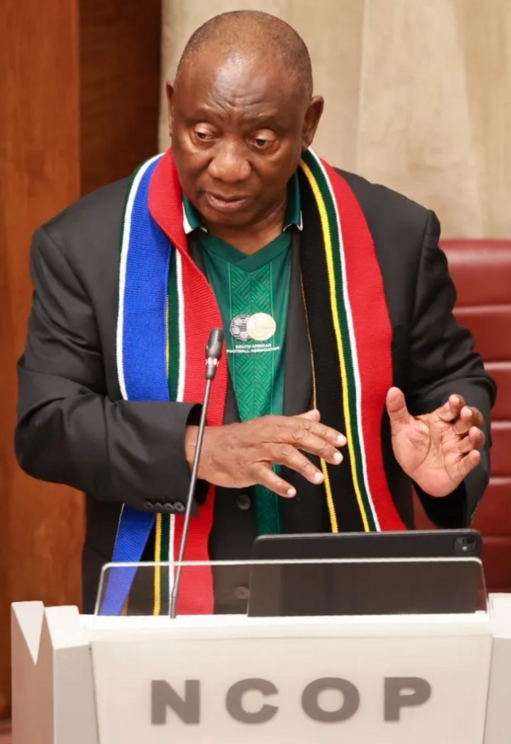
President Cyril Ramaphosa defended South Africa’s non-aligned foreign policy in the NCOP, saying it enables engagement with global powers while protecting sovereignty, promoting dialogue and advancing national interests internationally.
Image: GCIS
President Cyril Ramaphosa has defended South Africa’s non-aligned foreign policy amid renewed questions in Parliament over the country’s relations with China, Russia and Iran, as well as tensions with the United States over trade tariffs and diplomatic positioning.
Ramaphosa’s remarks come after US Ambassador to South Africa Leo Brent Bozell III criticised South Africa’s non-aligned foreign policy stance on X, referencing its engagements with China and Iran, including Deputy President Paul Mashatile’s visit to Beijing.
Answering questions during a National Council of Provinces (NCOP) question and answer session on Thursday, Ramaphosa said South Africa’s foreign policy is grounded in the Constitution and guided by principles of human rights, peace, multilateralism and a rules-based international order.
He said the country engages globally on the basis of sovereign equality, mutual respect and non-interference, adding that South Africa does not regard itself as having enemies.
“We don’t see ourselves as a country of enemies. We are a country that seeks to be at peace with all other countries and have good relations with all,” Ramaphosa said.
He said South Africa maintains diplomatic relations across different regions and political systems in pursuit of national interests and constructive global engagement, consistent with its non-aligned and strategically autonomous stance.
Ramaphosa said this approach allows the country to engage with both Western and Eastern powers, including the United States, China, Russia, Iran, and others, through bilateral and multilateral platforms aimed at dialogue, cooperation, and dispute resolution.
He said non-alignment does not mean neutrality or disengagement.
“This does not imply neutrality or disengagement, but rather an independent foreign policy that seeks to promote dialogue, cooperation and peaceful resolution of global challenges,” he said.
Ramaphosa said the government will continue to engage international partners in a balanced and principled manner, including the United States, despite differences.
“Even in areas where we disagree, even in areas where we do agree, we continue to engage, because non-engagement does not serve any of us any good,” he said.
He said South Africa values its long-standing relationship with the United States and continues cooperation in areas such as trade, investment, health, education and security.
Ramaphosa also defended South Africa’s participation in joint military exercises with various countries, saying such engagements are routine and not inconsistent with non-alignment.
He said these exercises, conducted with countries including the United States, China and India, allow for the sharing of experience, capabilities and approaches to security and peacekeeping.
“We do from time to time have military or naval exercises with a number of countries, including the United States, including a number of Western countries, and countries that are in the East, India, China and many others,” he said.
Ramaphosa said South Africa has not compromised its sovereignty or independence in its engagements, insisting that the country remains self-respecting and principled in its foreign relations.
He said South Africa continues to play a constructive diplomatic role in global conflicts, including the war between Russia and Ukraine, where it maintains engagement with both sides.
“We are one of those very few countries that has been able to do a number of things to give assistance to the resolution of the conflict,” he said.
Ramaphosa said South Africa is often able to engage with parties on both sides of international conflicts, and is sometimes asked to pass on messages between them.
He also said South Africa’s non-aligned stance allows it to engage widely on trade disputes, including tariff measures imposed by major economies.
He said the government has intensified economic diplomacy in response to global tariff pressures, aiming to expand and strengthen trade relations.
“We have decided to turbocharge our economic diplomacy and reach out to many countries around the world with a view of establishing sustainable trade relations with them,” he said.
Ramaphosa said South Africa’s participation in international organisations such as BRICS, the United Nations, the Commonwealth and the Non-Aligned Movement is voluntary and based on national interest.
He said the government uses a range of diplomatic tools to advance its position on issues such as steel, critical minerals and global trade disputes.
Responding to criticism that South Africa is not consistent in its approach to authoritarian states, Ramaphosa said foreign policy is guided by constitutional values but applied using different diplomatic instruments depending on context.
He said the government does not remain silent on issues of principle, particularly where human rights are concerned, including recalling South Africa’s history under apartheid.
“We will not be quiet. We will speak up,” he said.
Ramaphosa said South Africa’s approach is deliberate, flexible and aimed at resolving disputes through engagement rather than confrontation.
IOL Politics
Get your news on the go. Download the latest IOL App for Android and IOS now