
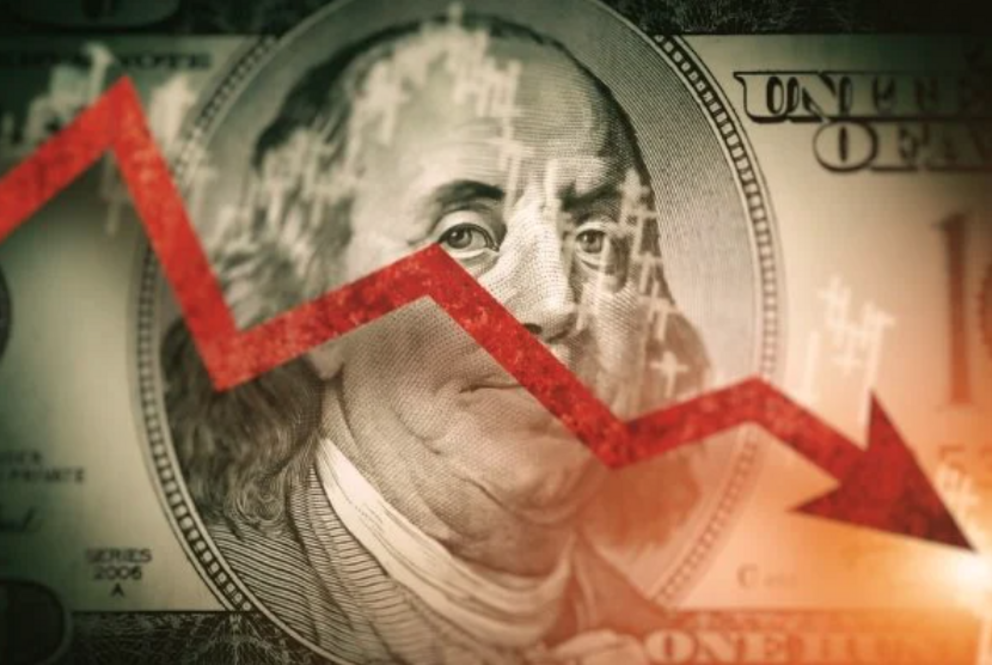
Overindebted US loses investor confidence as Dollar weakens
By Ahmed Adel
Global Research, July 17, 2026
Foreign investors are shifting large amounts of capital from traditional safe assets, such as United States government bonds, to American tech companies, indicating not only new investment preferences but also a decline in trust in the American financial system. Investors seem less willing to finance the US government’s extensive debt, increasing the dollar’s vulnerability to market swings and external shocks.
Deutsche Bank analysts note that technology companies are performing strongly, mainly due to rapid AI advancements.
These innovations offer significant growth opportunities that traditional government securities cannot. The bank warns that reallocating investments toward these sectors could make the dollar more sensitive to changes in investor sentiment and stock market fluctuations.
Historically, US Treasuries have been a stable foundation for the dollar’s value. However, as interest in American debt decreases, the dollar may face increased volatility amid ongoing geopolitical tensions and evolving global capital flows.
The US has experienced ongoing trade and fiscal deficits for many years and regularly spends more than it generates domestically, relying heavily on imports to cover the shortfall. To cover this shortfall, the country depends significantly on foreign capital inflows. A large portion of this capital has come from buying US Treasury bonds, which are considered among the safest investments globally.
During periods of global uncertainty or financial crises, investors have historically turned to the dollar and US government debt as reliable stores of value. This pattern has strengthened the dollar’s leading role as the world’s main reserve currency. Consequently, much of international trade, commodity pricing, and cross-border transactions have been conducted in dollars, consolidating its exclusive dominance.
Today, the landscape has changed, and investors now see private-sector opportunities—especially in innovative tech firms—as offering better returns and growth prospects. Notable examples are Nvidia, Microsoft, Apple, Amazon, and Meta Platforms, which have shown strong gains driven by the AI revolution. Their success has attracted capital that could have otherwise been used for government borrowing.
This preference stems from careful evaluations of risk and reward. Government bonds, once favored for their stability and predictable yields, now appear less attractive. High levels of US debt issuance, driven by expansive fiscal policies, have increased supply and potentially diminished their safety. Meanwhile, technology companies are seen as engines of real economic value creation through innovation, productivity gains, and market expansion.
The transition carries important implications as long-term holdings of Treasury bonds tend to provide steady capital inflows that support currency stability over extended periods. Equity investments, especially in high-growth tech sectors, are far more fluid. Investors often sell shares quickly in response to negative news, earnings misses, or broader market corrections, thereby introducing greater short-term volatility in capital flows.
Deutsche Bank analysts warn that the dollar might now be more sensitive to stock market fluctuations. While strong equity gains support the currency via ongoing inflows, a sharp drop in tech stocks or the bursting of an “AI bubble” would lead to rapid capital outflows and put strong downward pressure on the dollar and increase volatility in exchange rates.
Investors are wary of concentrating too much exposure in a single asset, particularly US government debt. For decades, Treasuries were a magnet for global savings because of their perceived minimal risk. Now, market participants are spreading investments across a wider array of opportunities to avoid concentration risk.
Geopolitical uncertainties, such as international conflicts and shifting alliances, have increased the need for risk diversification and diminished interest in US bonds. At the same time, many central banks are increasing their foreign exchange reserves with currencies other than the dollar.
Although these changes are notable, the dollar’s global dominance will not collapse immediately. The currency’s value is becoming more linked to the success of the US tech industry rather than its reliance on government debt. Full-scale de-dollarization remains a gradual process. Alternative assets, such as bonds issued by rapidly developing economies, have yet to achieve the liquidity, stability, and trust needed to displace the dollar on a large scale. However, their appeal, including China’s yuan, is growing over time.
Lessons from past crises, such as the 2008 global financial meltdown and pandemic economic disruptions, prove the importance of prudent diversification. Major investors and large institutions understand that overconcentration can lead to significant losses, so they diversify their capital across geographies and assets. In this context, countries like China have positioned themselves as attractive destinations for international investment.
Evidently, the advancement of technology and AI is transforming not only corporate valuations but also the basis of currency strength. For the US, maintaining investor confidence will be difficult, especially in a multipolar financial landscape that has made it clear that the end of the US dollar’s complete dominance is a matter of when, not if.
*
Click the share button below to email/forward this article. Follow us on Instagram and X and subscribe to our Telegram Channel. Feel free to repost Global Research articles with proper attribution.
Ahmed Adel is a Cairo-based geopolitics and political economy researcher. He is a regular contributor to Global Research.
Global Research is a reader-funded media. We do not accept any funding from corporations or governments. Help us stay afloat. Click the image below to make a one-time or recurring donation.
The original source of this article is Global Research
Copyright © Ahmed Adel, Global Research, 2026