
Oil tops $100: Trump’s warmongering 'punishes' Americans, not Iran
Thursday, 23 July 2026 6:36 PM [ Last Update: Thursday, 23 July 2026 6:50 PM ]
The escalation follows President Donald Trump's formal notification to Congress on July 7 that military aggression against Iran had resumed.
Iranian Parliament Speaker Mohammad Baqer Qalibaf has sarcastically rebuked the US over soaring global oil prices above $100 a barrel, declaring that Washington's escalation against Iran has backfired spectacularly, punishing American consumers instead of Tehran.
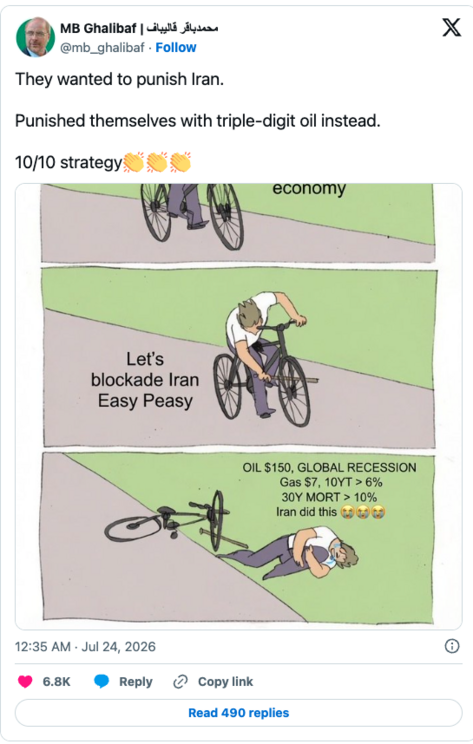
"They wanted to punish Iran. Punished themselves with triple-digit oil instead. 10/10 strategy," Ghalibaf wrote on X on Thursday.
He shared an image illustrating how the US naval blockade on Iran and resumed strikes have pushed gasoline prices above $7 a gallon in the United States.
The reaction came as Brent crude oil surged 7.1% to $100.74 a barrel on Thursday – its highest level since May – following attacks by Yemen's Ansarullah movement on two Saudi oil tankers in the Red Sea, amid supply disruptions already caused by Washington's illegal blockade of the Sea of Oman.
Mohammad Mokhber, senior adviser and assistant to Iran's leader, warned in a separate social media post that the $100 price is "solely the result of disruptions to transportation, not production," and that continued US aggression will have broader global consequences.
"The fire that the United States is igniting in the region's oil and gas fields will ultimately spread across the entire world," Mokhber said, adding that Iran's armed forces will "define the battlefield and the level of the game one step above the enemy."
Iran has imposed restrictions on transit of vessels in the Strait of Hormuz following continued US attacks on Iranian soil since last week in violation of the war-ending memorandum of understanding signed by Tehran and Washington in June.
The US escalation has disrupted shipping through one of the world's most important energy chokepoints, fueling concerns over global crude supplies and contributing to a sharp rise in oil prices.
Qalibaf said on Wednesday that the Strait of Hormuz situation will not return to its pre-war state, warning that "no country in the region will be able to sell oil if Iran is prevented from doing so."
"In a region where we cannot sell oil, no one will sell oil," Qalibaf wrote on X, describing the war as an "all or nothing" equation.
The escalation follows President Donald Trump's formal notification to Congress on July 7 that military aggression against Iran had resumed – a move that effectively tore up the 14-point memorandum of understanding signed with Tehran just weeks earlier, which had committed both sides to ending the war and lifting the US naval blockade.
Washington has since launched 13 consecutive nights of terrorist strikes across Iran, targeting increasingly civilian infrastructure including bridges, power plants, and the under-construction Darkhovin nuclear power plant.
The strikes have killed dozens of civilians and wounded hundreds, according to Iranian health officials.
Trump has threatened to destroy "one bridge or power plant" for each ship attacked in the Strait of Hormuz, including targets in or near Tehran.
Iran has responded with retaliatory missile and drone strikes on US bases in Jordan and Bahrain, and has vowed to strike US-linked energy infrastructure across the region if American attacks continue.
Ansarullah, the Yemeni movement, said on Thursday it struck two Saudi oil tankers – the Encelia and the Layla – in the Red Sea, setting one ablaze, as part of a naval blockade against Saudi shipping through the Bab el-Mandeb strait.
The movement described the attacks as a legal and defensive response to the Saudi-led blockade on Yemen and recent strikes on Sanaa's international airport.
The actions have opened a second critical chokepoint, with Goldman Sachs estimating that nearly 9 million barrels per day of oil flows through the Bab el-Mandeb, including 4 million barrels that would be difficult to reroute.
The price surge has sent shockwaves through global markets, with US stocks tumbling sharply on Thursday.
Alphabet and Tesla led the declines, falling 6.7% and 14% respectively, dragging the S&P 500 down 1.3% as investors braced for higher costs to ripple through the economy.
US gasoline prices have climbed to an average of $4.09 a gallon, up from $3.93 a month ago, according to AAA.
Analysts warn that a sustained $100 oil price could push US inflation above 4% – well past the Federal Reserve's 2% target – potentially forcing the central bank to raise interest rates for the first time since 2023.
The 10-year Treasury yield has risen to 4.70% from just 3.97% before the war began, pushing long-term US mortgage rates to their highest levels in nearly a year.
Goldman Sachs expects oil prices to retain most of their recent gains through July and August as global inventories continue to decline amid lower West Asia production and seasonal summer demand.
European markets also suffered steep losses on Thursday, with France's CAC 40 dropping 1.6%, as the energy shock threatens to derail a fragile economic recovery across the continent.
Press TV’s website can also be accessed at the following alternate addresses: