
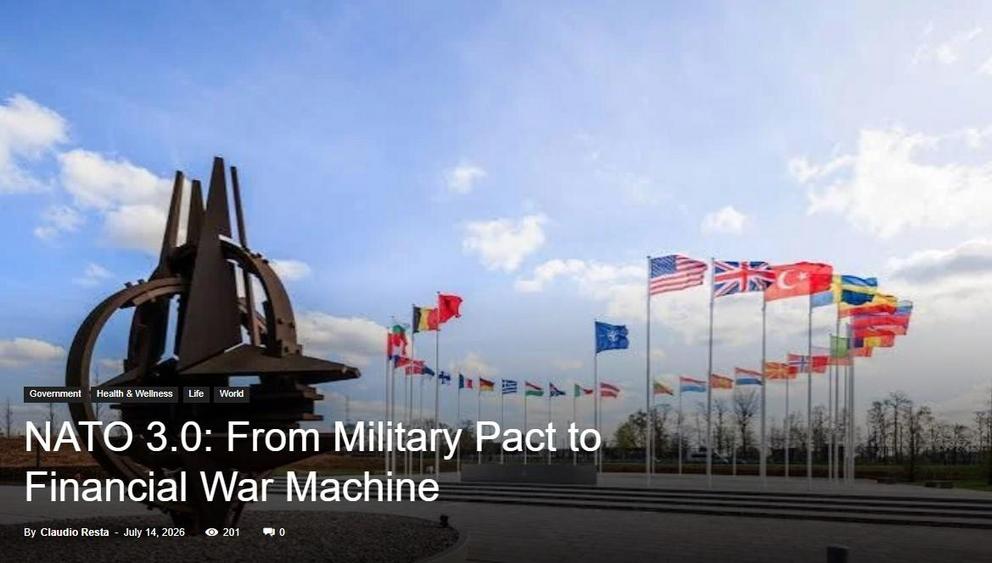
NATO 3.0: From military pact to financial war machine
By
-
July 14, 2026
Become a VT Supporting Member Today
Please keep VT Radio and VT Foreign Policy alive! Donate today to make sure VT stays on the internet free and clear of Big Tech control! Donate today:
The Ankara summit marks a turning point that it would be naive to dismiss as yet another ritual meeting of the Atlantic Alliance. We are not witnessing a simple diplomatic conference, nor a technical discussion on the distribution of military spending.
We are witnessing a fundamental transformation.
The NATO that emerged in 1949 as the military architecture of the Cold War, and the one that expanded after the collapse of the Soviet Union to encompass Central and Eastern Europe, now seem to be giving way to a different organism: a political-financial structure in which security becomes a market, threat becomes debt, defense becomes income.
The phrase “NATO 3.0” captures this very shift.
No longer just a military alliance, but a platform for mobilizing capital, industrial contracts, investment funds, banks, defense companies, and governments subordinated to a mechanism centered in the United States.
Ankara is important not only because of what is said in official communiqués.
It’s important for what’s happening around the summit: the great defense industry forum, the billion-dollar deals, the appeal to private capital, the increasingly visible connection between finance and war.
NATO, in short, no longer limits itself to preparing armies. It prepares markets. It doesn’t just organize operational plans. It organizes cash flows.
It no longer asks only for soldiers, bases, and political support. It asks for public budgets, private savings, pension funds, bank investments, and permanent debt.
Defense as a new, inverted welfare system
The message coming from Ankara is simple and brutal: military spending must no longer be considered a cost, but an investment.
The problem is understanding for whom. For European citizens, who already see healthcare, education, infrastructure, and public services undergoing a constant slimming diet, the increase in military spending signifies a clear choice of priorities.
It means that the state is becoming stronger, but not to protect society.
It is becoming stronger to finance war, secure orders, ensure profits, and support companies that thrive on public contracts and controlled technologies. This is the great political reversal of the current era.
For decades, we’ve been told that the state must retreat, that there were no resources, that public debt was the ultimate evil, that social spending had to be curtailed in the name of the markets.
Today, suddenly, when it comes to defense, money reappears.
Not only that: it becomes urgent, necessary, moral.
There’s no longer any debate about whether spending hundreds of billions on armaments is sustainable; the only debate is how to find the money.
Hence the idea of a NATO bank, proposed as a tool to help member countries sustain increasingly burdensome financial commitments.
The formula is elegant: coordinate capital, organize investments, strengthen the industrial base.
The substance is less elegant: transform security into a cycle of debt, channel public and private resources toward the military-industrial apparatus, make war a stable component of Western financial accumulation.
It’s the inverted welfare of the new era: less social protection, more armed protection; less investment in civilian life, more investment in war production; fewer guaranteed rights, more strategic obligations.
This is the so-called Rearmament Bank.
The Defense, Security and Resilience Bank (DSR Bank) has taken a decisive step, moving from a theoretical proposal to a financial institution in the formal launch phase with the signing of the Joint Declaration for the bank’s establishment.
It has been officially confirmed that its headquarters will be in Canada (Montreal and Toronto were the key cities in the negotiation phase), with two European hubs: coincidentally, Luxembourg has been designated as the headquarters for European operations, while Romania will host the regional office for the “Southern Flank” in Bucharest.
Currently, the group of “founding members” is led by Canada (under the pressure of the much-lauded Prime Minister Mark Carney) and includes nine countries: Canada, Albania, Belgium, Greece, Latvia, Luxembourg, Romania, Turkey, and Ukraine; the latter, although it is not a member of NATO.
The United Kingdom has not joined because it already has another DSR Bank project, together with the Netherlands (the Multilateral Defense Mechanism).
Banks that are technically supporting the launch of the DSRB or have joined the defense financing vision include: Royal Bank of Canada (RBC), J.P. Morgan, Scotiabank, Business Development Bank of Canada, Deutsche Bank, BNP Paribas, Banco Santander, Barclays, ING, Commerzbank and NatWest, PKO Bank Polski (Poland), and Danske Bank.
The Resilience Bank aims to obtain the highest credit rating to issue so-called “Resilience Bonds” (bonds for the defense) at very low rates on the global market with the aim of raising and managing up to 100 billion pounds (about $134 billion) to finance weapons purchases.
We could really do without this multilateralism.
The project’s current “managers” are Rob Murray, former head of NATO Innovation. He is the project’s main architect, with the idea of creating a tool that allows private individuals to invest in defense with reduced risk; Stephen Kelly, with a high-profile background in the British government (Cabinet Office); together with former NATO generals, former Pentagon officials, and veterans of international finance (such as former executives of Goldman Sachs and Barclays).
Without much fanfare, Ankara has created yet another piece of the arms race and the collection of global savings for a war economy, raising the level of international conflict through the institutional normalization of finance that profits from militarization.
The Military-Industrial Complex and Cost-Inflating Capitalism
The heart of the problem isn’t just the amount of money spent on defense. It’s the relationship between money spent and actual military capability.
The United States spends enormous sums, more than any other global player. Yet the war in Ukraine and tensions in the Persian Gulf have exposed a surprising fragility: difficulty producing munitions in adequate quantities, a shortage of interceptors, strategic stockpiles under pressure, and weapons systems that are extremely expensive but not always reproducible on a large scale.
Here the structural crux emerges: the Western system, especially the US, is not organized to win long wars of industrial attrition.
It is organized to generate profits through complex, expensive, technologically sophisticated, often fragile programs, always dependent on continuous upgrades.
The F-35 fighter jet is the emblem of this model: a huge, extremely expensive, politically guarded, industrially branched program, but also plagued by delays, technical problems, and cross-dependencies.
The logic is not that of pure military efficiency. It is that of cost maximization. If the primary goal becomes the profit of supplier companies, the system does not necessarily aim to produce simple, numerous, robust, and easily replaceable weapons.
It aims to produce complex platforms, multi-year contracts, mandatory maintenance, closed supply chains, and technological dependence.
Russia, despite its much smaller economy, has demonstrated a different capability: centralized production, state control, controlled costs, priority on quantity, and continuous adaptation to the battlefield.
The confrontation is not between democracy and authoritarianism, as propaganda would have it. It is between two economies of war.
On the one hand, a financialized apparatus that transforms defense into revenue; on the other, a state apparatus that subordinates industry to military objectives.
Europe as a customer, not an ally
The most important transformation concerns Europe. The old discourse on European strategic autonomy increasingly appears like an empty phrase. Europeans talk about sovereignty, but buy US systems.
They talk about common industry, but integrate into production chains dominated by large American contractors.
They talk about European security, but accept standards, technologies, priorities, and constraints set in Washington.
The result is a NATO composed of few real members and many clients.
The United States sells security; the Europeans buy it.
The United States supplies weapons systems; the Europeans go into debt to purchase them.
The United States retains control of crucial technologies; the Europeans produce components, participate in programs, and obtain some industrial returns, but remain in a subordinate position.
Germany is the most obvious case. Its rearmament is presented as a return to German power, but this should be interpreted with greater caution. A massive increase in the military budget does not automatically translate into military strength. It can, more simply, translate into a transfer of public resources to companies seeking a way out of the crisis of the civilian industrial model. The German automobile industry is under pressure: lost Russian energy, more expensive raw materials, increasingly advanced Chinese competition. The temptation is to transform part of German industrial capitalism into war capitalism. But a nation that converts growing parts of its civilian economy into a military economy does not necessarily become stronger. It can become more rigid, more dependent on the state, more exposed to external geopolitical decisions, more similar to those late systems that compensate for the loss of productive vitality with permanent mobilization. Article 5 and the illusion of automatic protection One of the most enduring myths is that the Atlantic Alliance’s fundamental principle is Article 5, often presented as an automatic guarantee of collective military intervention. But this automatic mechanism isn’t about war. It’s about political consultation. In the event of an attack on a member country, the other allies consult and decide on the measures deemed necessary. There is no mechanism whereby everyone automatically goes to war against the aggressor. This ambiguity has been useful for decades. It has allowed Europeans to believe they were protected without truly gaining autonomy. It has allowed the United States to maintain bases, influence, and political control over Europe without fully committing to risking its own survival to defend it. During the Cold War, NATO’s true function was threefold: keeping the Russians out, the Germans down, and the Americans in. Today, that formula only appears to change. The Russians remain the useful enemy, the Germans are rearmed but within a controlled perimeter, and the Americans remain inside but with a different objective: not so much to defend Europe as to monetize its dependence. Trump has made explicit what other presidents had maintained in a more diplomatic form. The American umbrella has a price. Protection has a price. Access to technology has a price. Geopolitical loyalty has a price. And, above all, it is paid by buying American. Finance, pension funds, and the dollarization of European savings The most disturbing development of NATO 3.0 concerns the involvement of private finance. When banks, funds, and large asset managers enter the defense industry on a permanent basis, war ceases to be merely a political decision and becomes an investment class. The line between national security and financial returns becomes blurred. Large global funds raise capital everywhere, manage it on a global scale, and direct it where the returns appear most promising. If defense becomes the major sector guaranteed by states, then European savings risk being channeled into the American military industry. In this sense, the issue concerns not only public budgets, but also private savings: pension funds, severance pay, asset management, insurance, and collective investment vehicles. This is where economic warfare takes on its most modern form. There’s no need to conquer a country if you control its financial infrastructure, its debt, its industrial standards, its military purchases, and even the use of its savings. Europe risks financing its own subordination. It pays to arm itself, but arms itself to other people’s standards. It invests in defense, but strengthens other companies. It mobilizes national resources, but inserts them into a political, technological, and financial chain of command it doesn’t control. This is the geoeconomic heart of the Ankara summit: not the defense of Europe, but Europe’s integration into a new militarized Western order, where sovereignty is replaced by compatibility with American strategic needs. Reduced globalization and militarized value chains The crisis of globalization does not mean an automatic return to national sovereignty. It means the emergence of a restricted, selective, and armored globalization. The United States has understood that the order built after the Cold War has produced a paradox: it has enriched Western capital, but has transferred industrial capacity, expertise, and production chains to Asia, especially China. The result is that Washington now finds itself competing with the country it helped grow. China has not become a domesticated Japan, nor a factory without political ambition. It has become the world’s manufacturing hub, a leading technological player, a power capable of controlling key segments of global supply chains. This is why the United States is now seeking to reorganize globalization on geopolitical grounds. It is no longer just about producing where it costs less. What matters is producing where political control is guaranteed. Factories must leave rival countries and move to the United States or other countries considered reliable. Tariffs are not just economic tools. They are instruments of imperial discipline. They serve to force allies, partners, and subordinates to realign. Europe, Japan, South Korea, and the Gulf countries are treated not as equal allies, but as capital reserves, forced markets, production platforms, and security buyers. In this sense, NATO also becomes an instrument for reorganizing Western globalization: less openness, more blocs; less free market, more armed market; less economic efficiency, more geopolitical loyalty. The European risk: paying for others’ wars For Europe, the outcome is harsh. The Ankara summit confirms that the continent is not building its own security. It is buying security decided by others. It is not creating strategic autonomy. It is deepening its own dependence. It is not using the crisis to regain its geopolitical status. It is becoming the main payer for Western military reorganization. Increased military spending, if not accompanied by political, industrial, and technological sovereignty, does not produce independence. It produces more costly subordination. Europeans risk finding themselves with less welfare, more debt, more American weapons, more Atlantic constraints, greater exposure to crises, and no real decision-making capacity. NATO 3.0 was born this way: not as an alliance of equals, but as a governing device for the West in crisis. A structure that monetizes fear, financializes defense, turns allies into clients, and uses the Russian, Iranian, or Chinese threat to impose a new economic and strategic discipline. Ankara has not only inaugurated a new phase for NATO. It showed the face of war in the age of finance capital: no longer just tanks, missiles, and military bases, but banks, funds, private savings, public debt, industrial chains, and technological dependence. War as a total market. Security as a product. Alliance as a contract. And Europe, once again, as the payer of last resort.
Thank to Giuseppe Gagliano and Alessandro Volpi
Claudio Resta was born in Genoa, Italy in 1958, he is a citizen of the world (Spinoza), a maverick philosopher, and an interdisciplinary expert, oh, and an artist, too.
Grew up in a family of scientists where many sciences were represented by philosophy to psychoanalysis, from economics to history, from mathematics to physics, and where these sciences were subject to public display by their subject experts family members, and all those who they were part of could participate in a public family dialogue/debate on these subjects if they so wished. Read Full Bio
Latest Articles (2023-Present)
Archived Articles (2019-2022)
VT Condemns the ETHNIC CLEANSING OF PALESTINIANS by USA/Israel
$280+ BILLION US TAXPAYER DOLLARS INVESTED since 1948 in US/Israeli Ethnic Cleansing and Occupation Operation
150B direct "aid" and $ 130B in "Offense" contracts
Source: Embassy of Israel, Washington, D.C. and US Department of State.
ATTENTION READERS
We See The World From All Sides and Want YOU To Be Fully Informed
In fact, intentional disinformation is a disgraceful scourge in media today. So to assuage any possible errant incorrect information posted herein, we strongly encourage you to seek corroboration from other non-VT sources before forming an educated opinion.
About VT - Policies & Disclosures - Comment Policy
Due to the nature of uncensored content posted by VT's fully independent international writers, VT cannot guarantee absolute validity. All content is owned by the author exclusively. Expressed opinions are NOT necessarily the views of VT, other authors, affiliates, advertisers, sponsors, partners, or technicians. Some content may be satirical in nature. All images are the full responsibility of the article author and NOT VT.