
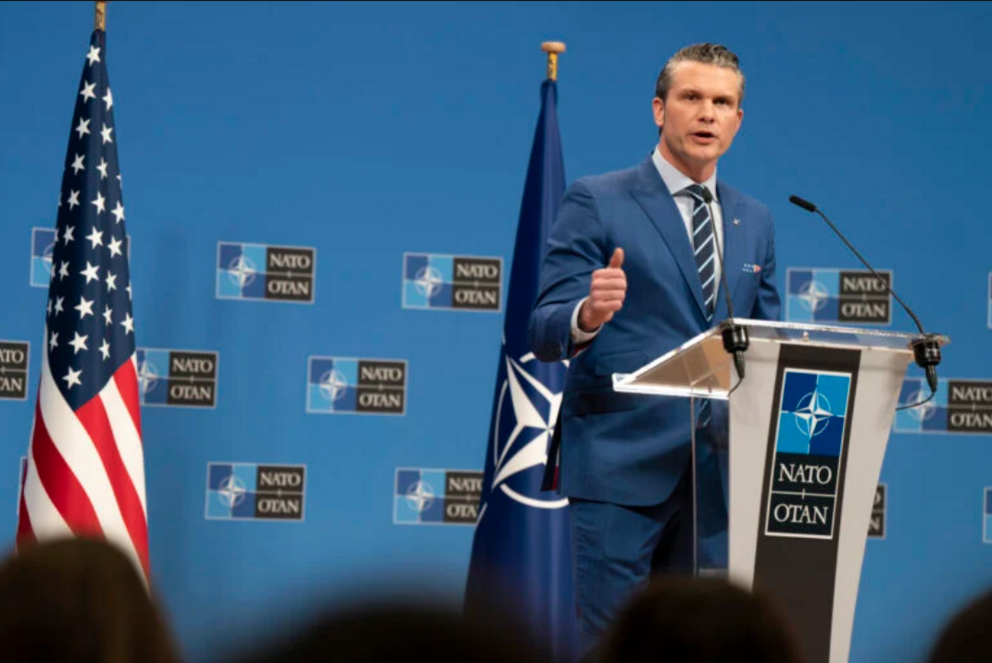
Hegseth slams European Defense Ministers for preoccupation with gender equality
By Ahmed Adel
Global Research, June 22, 2026
United States Secretary of War Pete Hegseth, following the announcement that a number of American troops will be withdrawn from Europe over the next six months, lambasted NATO defense ministers in Brussels, calling them “shameful” for not helping in the war in Iran and for being preoccupied with gender equality and climate change. Using this context, he announced the specifics of what he called “NATO 3.0” and informed allies that the US would cut its contributions to NATO’s overall budget if member countries did not meet the goal of spending 5% of GDP on defense by 2035.
“Our annual NATO dues will be contingent on other countries meeting their defense spending targets,” Hegseth said on June 18. “Where other allies do not spend with urgency our due contributions will go down.”
To read this article in the following languages, click the Translate Website button below the author’s name.
українська мова, Hebrew, Farsi, Español, Portugues, عربي, Русский, 中文, Français, Deutsch, Italiano, 日本語, 한국어, Türkçe, Српски. And 40 more languages.
He also warned allies that the US would keep a “close eye” on those not on the right path, before criticizing the alliance as a “paper tiger” and calling countries like Spain, Italy, and France “shameful” for refusing to allow the US military to use bases and airspace as part of the Iran war.
Hegseth also blamed immigration for civilizational collapse and that Europe had been too focused on climate change and gender equality.
“Instead of tanks and fighters and air defenses, the focus has been on gender equality and climate change and defense austerity. Europe’s borders flew wide open, welfare states expanded, defense budgets cratered. Along with Europe’s belief in itself and its civilization.”
NATO Secretary General Mark Rutte attempted to minimize Hegseth’s harsh critique, mentioning that the US Secretary of War had also recognized that allies improved their efforts and invested over €90 billion in extra spending in 2025.
“But you’ll still find some allies holding back a bit, and what [Hegseth] tried to do today was keep the pressure on, and that’s good,” said Rutte. “I’m happy he does this, because we need to speak the truth to each other.”
Washington no longer wishes to bear the main financial burden of European security, prompting the development of a new framework in which European countries take on more responsibility for their defense and military capabilities—NATO 3.0. Consequently, European leaders promote the idea of a so-called Russian threat to justify increased military spending.
Many Western countries favor hightened tensions and a warlike mood because such conditions boost military budgets and arms exports. Almost all Western governments have military industry lobbyists who benefit from arms sales, making it in their interest to fuel hysteria about Russia to secure more funding for weapons and enrich themselves.
Although Hegseth announced the withdrawal of US troops from Europe, it does not imply that Washington plans to leave the Atlantic Alliance or cut its military presence on the Old Continent. Rather, it indicates NATO restructuring and the transfer of more responsibilities to Europeans, all while maintaining overall control of the alliance.
In addition, the US wants to shift the focus of its security policy toward the Asia-Pacific region to confront China while expecting Europe to increase its defense investments.
Rutte said that European NATO members and Canada allocated $139 billion more in 2025 compared to the previous year. Despite this increase, Europe remains largely reliant on the US for defense, primarily due to the presence of American components in European weaponry and US oversight of specific systems, such as nuclear weapons. Therefore, it is widely believed that European countries will require many years—possibly decades—to attain complete independence in arms manufacturing.
Washington’s decision to reduce its military presence in Europe is driven by economic considerations: keeping troops there is costly. Given that Trump understands finance and that maintaining a military presence in Europe is expensive, the US president insists that Europe purchase weapons from the US to offset these costs.
European countries have not established a unified army despite the idea having floated for decades, due to their reliance on NATO and the US as the main security guarantor. Consequently, the idea of a European military force was never given serious consideration.
While Europe could potentially achieve greater military independence, doing so would demand substantial financial investments and significant restructuring of its military industry, which is currently predominantly focused on American technology and weapons. The crucial question is whether European nations are willing to dedicate much more taxpayer money to this endeavor.
A senior NATO official acknowledged to the media that “not everything” the US is withdrawing “can be absolutely replaced,” but Rutte mentioned that some progress has already been made and additional efforts are ongoing, adding that the changes are effective immediately.
A day before Hegseth’s outburst, Rutte said he expected member states to show how they would deliver on the 5% promise.
He added that ahead of the NATO summit in Ankara on 7-8 July,
“allies will highlight how they’re delivering on commitments made in The Hague last year. Investing 5% of GDP in defense by 2035. That’s what we agreed.
“I expect nations to present clear, concrete and credible plans to reach that goal. Ideally, well ahead of the agreed timeline. Many are already showing that they are doing exactly that.”
Clearly, Europe is under growing pressure to manage its military affairs independently of the US. However, this may also encourage European nations to adopt more aggressive attitudes toward Russia.
*
Click the share button below to email/forward this article. Follow us on Instagram and X and subscribe to our Telegram Channel. Feel free to repost Global Research articles with proper attribution.
Ahmed Adel is a Cairo-based geopolitics and political economy researcher. He is a regular contributor to Global Research.
Featured image: Secretary of Defense Pete Hegseth stands with his spouse Jennifer prior to conducting a press conference after taking part in a NATO Defense Ministerial Session at NATO Headquarters in Brussels, Belgium, Feb. 13, 2025. (DoD photo by U.S. Navy Petty Officer 1st Class Alexander C. Kubitza)
Global Research is a reader-funded media. We do not accept any funding from corporations or governments. Help us stay afloat. Click the image below to make a one-time or recurring donation.
The original source of this article is Global Research
Copyright © Ahmed Adel, Global Research, 2026