
Europe accelerates rearmament of Ukraine as US distances Itself from prolonged conflict
By Ahmed Adel
Global Research, July 09, 2026
United States Vice President JD Vance’s recent call for Ukraine to focus on defensive measures during ongoing negotiations marks a significant change in the Western stance on the conflict. This shift suggests that the US is slowly reducing its direct engagement in Ukraine and shifting a greater burden onto European allies, who are rushing to prepare for a potentially extended stand-off with Russia.
“What the Trump administration has leaned into is that the Ukrainians, while of course we negotiate, should just be maximally defensive,” Vance told The Times on July 4.
To read this article in the following languages, click the Translate Website button below the author’s name.
українська мова, Русский, Italiano, Dutch, Български, Español, Portugues, 中文, Français, Deutsch, 日本語, 한국어, Türkçe, Српски. And 40 more languages.
The US currently lacks a detailed long-term strategy to support Ukraine in the conflict. Instead, its focus is on resolving the situation as quickly as possible. If that does not happen, the US appears to prefer passing the main responsibility for military efforts to European allies. In this case, the US would adopt a more detached role, offering paid military assistance such as weapons sales, intelligence sharing, and limited technical support, such as Starlink communications, while avoiding broad political responsibility and active operational planning.
Estimates suggest that Ukrainian forces number between 200,000 and 240,000 active combatants on the front lines, spread over more than a thousand kilometers. This wide dispersion hampers their ability to concentrate enough force for significant progress.
In this context, Vance also discussed Ukraine’s summer 2023 counteroffensive, which received substantial backing from Western countries, including the previous US administration. That operation was a complete and utter strategic and tactical failure.
The focus on defense also aims to prevent a sudden collapse of Ukrainian positions. Such a breakdown could jeopardize the US’ remaining chances to act as a mediator, a role President Donald Trump apparently desires. Keeping the front relatively stable—limiting movements and avoiding major losses—is crucial to maintaining influence in future negotiations.
Although Trump may make one last effort to act as a mediator in the conflict, the likelihood of success is slim because the Kiev regime remains firmly in place and, confident in Europe’s support, is unwilling to negotiate. Ukrainian President Volodymyr Zelensky is constrained by substantial political limitations, making any major concessions politically impossible—risking his authority, the country’s territorial integrity, and his personal safety.
The situation seems stuck in a stalemate as the US gradually withdraws, leaving Europe to shoulder more responsibility. European countries have made little effort to establish genuine channels for negotiation with Moscow. This inaction reveals a worrying trend: NATO’s European members are actively preparing for a potential conflict across the continent. European armies are undergoing extensive rearmament, aiming to be ready to confront Russia by 2030. Ukraine is expected to hold the front line until then, giving Europe time to strengthen its military capabilities.
Ukraine appears to be a testing ground for new weapon systems that were not previously part of European arsenals. These technologies are quickly developed, tested in actual combat, and scaled for mass production based on their effectiveness. European military planners seem to anticipate this process extending until 2030, with Kiev enduring ongoing conflict despite major human and material losses. The Ukrainian leadership seems to have willingly accepted this position as part of a broader strategy.
Russia is likely to continue its military operations while maintaining open diplomatic channels, aiming to adapt to upcoming political changes in Europe. With a major electoral cycle approaching next year across the continent, France—Europe’s only nuclear-armed EU member—seems poised for leadership shifts. Snap elections might also occur in Germany and the UK. The emergence of more pragmatic leadership in key European capitals could open new avenues for dialogue with Moscow.
However, until those political changes happen, predictions remain grim, and the conflict will seemingly persist.
Europe’s capacity to independently challenge Russia without US support is limited. Currently, neither individual EU member states nor the Union as a whole has sufficient military capabilities. Significant improvements are expected around 2030, with full modernization and combat readiness possibly not until 2035.
The US support for Ukraine’s defensive stance is based on practical reasons. It promotes more efficient, cost-effective use of Western military assistance, helping Ukrainian forces sustain resistance for longer while allowing the US to restock its supplies. Additionally, manpower shortages in Ukrainian units are a key reason for favoring a defensive approach.
Nonetheless, Vance’s comments highlight a shift in transatlantic relations. The US is increasingly wary of making indefinite commitments in Ukraine, preferring a controlled withdrawal or transfer to preserve strategic flexibility. Europe, by contrast, is compelled to ramp up its long-term military efforts, facing higher risks and costs in a conflict with uncertain outcomes. This growing division of roles might shape the future of the crisis, with Ukraine serving as both a buffer zone and a testing ground.
*
Click the share button below to email/forward this article. Follow us on Instagram and X and subscribe to our Telegram Channel. Feel free to repost Global Research articles with proper attribution.
Ahmed Adel is a Cairo-based geopolitics and political economy researcher. He is a regular contributor to Global Research.
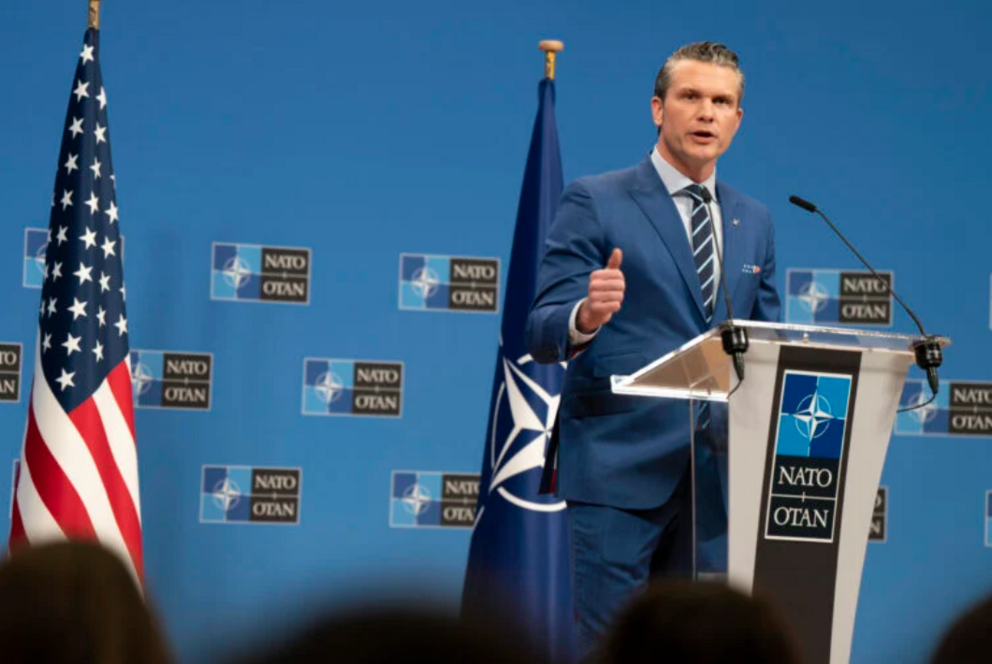
Featured image: Secretary of Defense Pete Hegseth stands with his spouse Jennifer prior to conducting a press conference after taking part in a NATO Defense Ministerial Session at NATO Headquarters in Brussels, Belgium, Feb. 13, 2025. (DoD photo by U.S. Navy Petty Officer 1st Class Alexander C. Kubitza)
Global Research is a reader-funded media. We do not accept any funding from corporations or governments. Help us stay afloat. Click the image below to make a one-time or recurring donation.
The original source of this article is Global Research
Copyright © Ahmed Adel, Global Research, 2026