
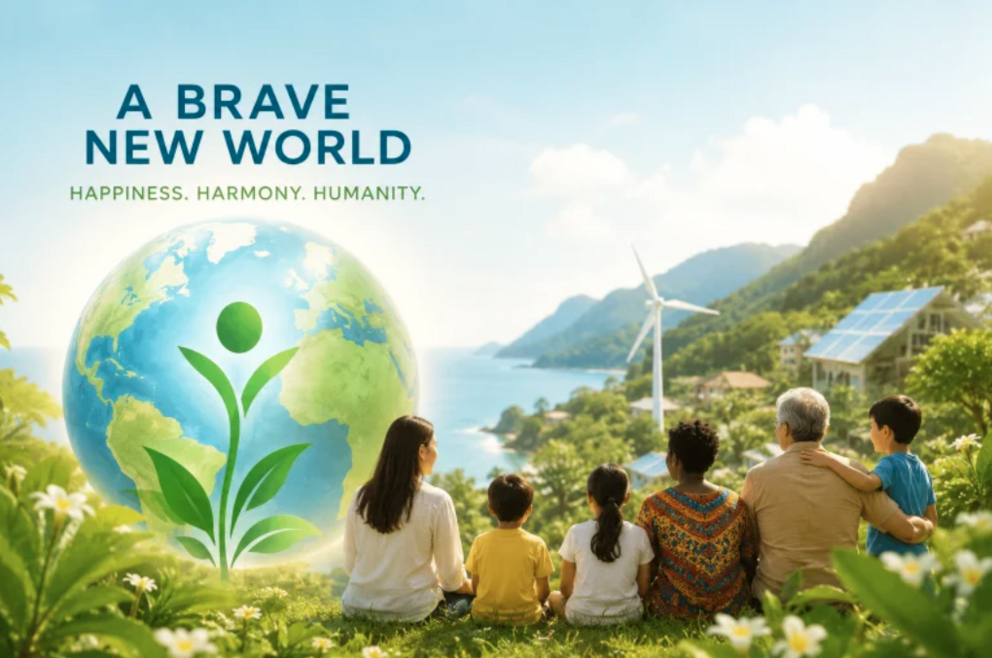
“Brave New World“ – Projecting a Humanitarian Future
By Peter Koenig
Global Research, June 14, 2026
Brave New World is a famous line from Shakespeare’s play “The Tempest”: “O, brave new world, that has such people in it!”
A “Brave New World” is not what Aldous Huxley described in his 1932 dystopian novel, of a fully controlled but happy society. Instead, it is a world where people live together in peace and harmony, can express themselves freely, and are able to maintain their cultural sovereignty and economic independence.
Such a world requires another level of awareness than what we have today. It supposes a conscious value system, where money is no longer the god of all wealth, stardom, and wellbeing.
It means a world that is de-digitized, with a takedown of tens of millions of health harming 5G antennas worldwide; a world where all-controlling smart phones are disappearing; a world where Starlink and other disguised satellite control programs are disabled; a world where climate engineering is a crime and must stop; a world where health policies are a matter of local autonomy, and where decisions over your body are your personal sovereign right; and a world where simply the truth prevails — the truth and nothing but the truth.
We must all recognize from deep inside our souls that today’s sense of “wellbeing” has been highjacked and indoctrinated with our Western value system for at least the past several hundred years.
It is encouraging, though, that we have today a few countries that have adopted a different set of values to account for their economic and spiritual wellbeing. Two come to mind, Bhutan and the South Pacific Island of Vanuatu. Both have developed a happiness index, instead of the linear all-round (worldwide) economic measuring stick of Gross Domestic Product (GDP). In Bhutan, their wealth index is called “Gross National Happiness” (GNH).
Vanuatu, instead, is consistently recognized on the “Happy Planet Index” (HPI), and has frequently ranked at the very top of the global HPI, which measures how efficiently nations deliver long, happy, and sustainable lives rather than purely focusing on economic output, i.e., the linear GDP measurement, the never-ending growth dimension, an in-your-face absurdity. The HPI was developed in 2006 by a London-based think tank, the New Economics Foundation. It is not yet officially recognized like GDP or the UN-created Human Development Index (HDI).
What is important, however, is that an increasing number of countries in Europe and even the United States are quietly studying what makes people happy and content, and identifying the key ingredients of societal well-being. Such well-being, much like the political principle of neutrality, serves as a foundation for peace and harmony.
Africa, for example, is emerging as a new population and economic force in the next 25 years. But “economically” probably not in the sense understood by most of the West today. In multi-cultural and even multi-dimensional Africa, money is unlikely remaining the key component of economic wealth or power. Other values, such as individual and societal wellbeing, spirituality, absence of violence and the knowledge of conflict resolutions, harmonious cohabitation and yes, happiness, are already today slowly emerging as what an awakening world is striving for.
No major societal or even civilizational shift has happened overnight. But most of them start with a dream and gradually evolve into a dynamic new reality. So, this dream will come through. Perhaps not tomorrow, maybe not during our lifetimes, and possibly not even the way we may imagine it today, but one day it will become a reality in ways that allow a worldwide peaceful cohabitation, with shared benefits for all.
*
Click the share button below to email/forward this article. Follow us on Instagram and X and subscribe to our Telegram Channel. Feel free to repost Global Research articles with proper attribution.
Peter Koenig is a geopolitical analyst, regular author for Global Research, and a former Economist at the World Bank and the World Health Organization (WHO), where he worked for over 30 years around the world. He is the author of Implosion – An Economic Thriller about War, Environmental Destruction and Corporate Greed; and co-author of Cynthia McKinney’s book “When China Sneezes: From the Coronavirus Lockdown to the Global Politico-Economic Crisis” (Clarity Press – November 1, 2020).
Peter is a Research Associate of the Centre for Research on Globalization (CRG). He is also a non-resident Senior Fellow of the Chongyang Institute of Renmin University, Beijing.
Featured image is AI-generated
Global Research is a reader-funded media. We do not accept any funding from corporations or governments. Help us stay afloat. Click the image below to make a one-time or recurring donation.
The original source of this article is Global Research
Copyright © Peter Koenig, Global Research, 2026