
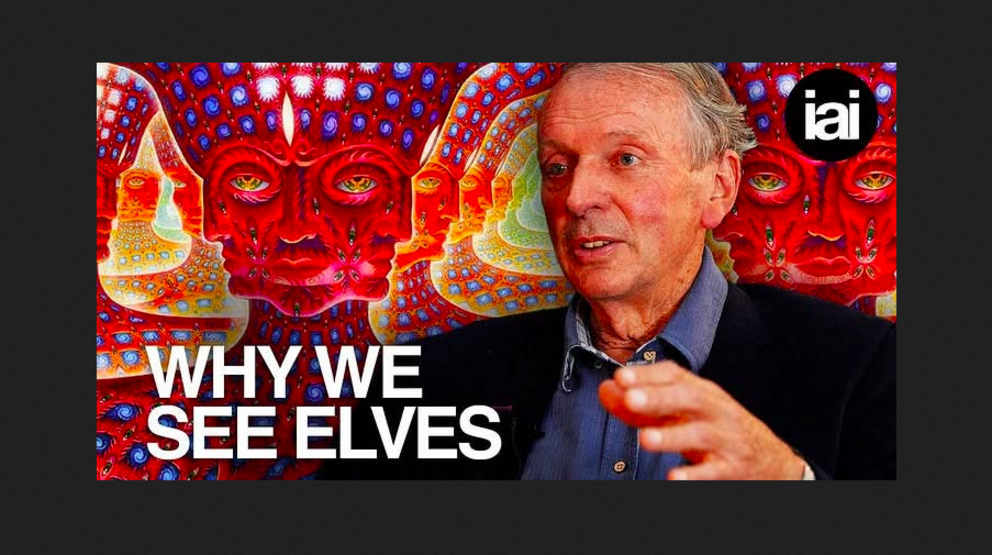
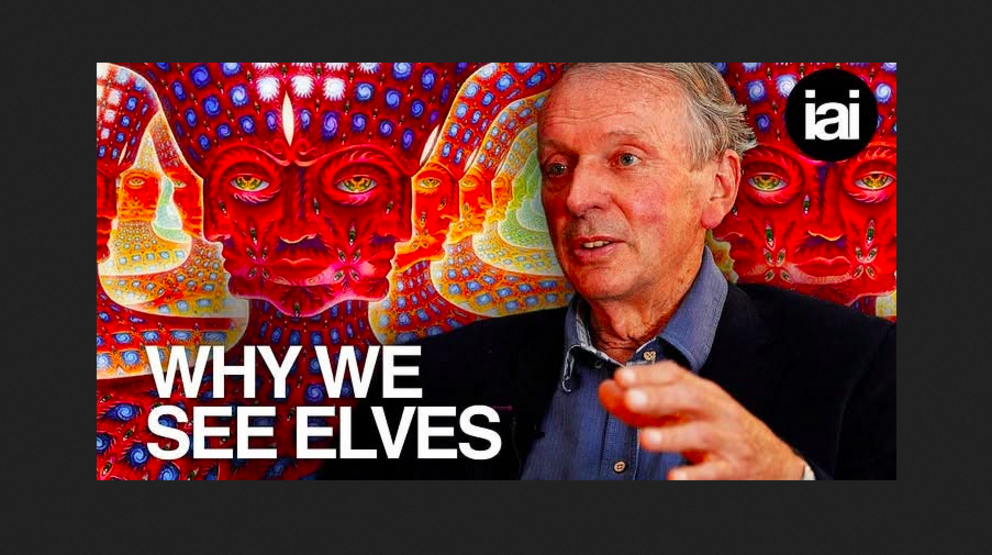
Why do people see elves when they take DMT?

What entities might reveal about memory, mind, and nature, with philosopher Peter Sjöstedt-Hughes

The reports are remarkably consistent: travellers on DMT describe meeting entities, beings, intelligences that seem to greet them, instruct them, even expect them, something I often discussed with Terence McKenna (as in trialogue 13). It’s a question philosopher of mind and metaphysics Peter Sjöstedt-Hughes is well placed to probe. His work centres on panpsychism and the philosophy of psychedelic experience, and he takes such reports neither as gospel nor as nonsense, but as data worth thinking about carefully.

In this clip we turn to those DMT entities directly. Are these visions purely private hallucinations, manufactured by the brain, or might they be glimpses of something more collective, a shared memory within nature of the kind I’ve explored through morphic resonance? Peter and I take the question seriously without pretending to settle it, and the conversation moves from the pharmacology of these states to what they might imply about the reach of mind beyond the individual skull.

It’s a small excerpt from a much longer and wide-ranging exchange about consciousness, memory, and where the edges of the mind really lie. With a free iai trial, you can watch the full conversation.

From the talk…

I got interested in this question in relation to dreams. Psychedelic experiences a few people have had, most people haven't, but everyone's had dreams, and in our dreams we enter a realm where all sorts of improbable things happen... So I thought, what about Ganesh in India, the elephant-headed god? He couldn't possibly have existed in the normal sense of the word, unless there were elephant-head transplants. He's a cultural image: on calendars, in statues, in temples, in people's houses. Almost all Hindus see Ganesh images all their lives. So I asked: does Ganesh appear in dreams? I went online and found Ganesh dream discussion groups, Indians discussing their Ganesh dreams. He's obviously more than a personal hallucination, because he's a collective phenomenon... Maybe he's a manifestation of a deeper principle that works through this image in people's dreams. Then it wouldn't just be a fancy hallucination in a particular person's mind.

The discussion took place in April 2022 at HowTheLightGetsIn, the IAI’s philosophy and music festival, which gathers scientists, philosophers and artists for exactly this sort of open-ended enquiry, the kind of setting where questions that polite science prefers to ignore can at last be asked aloud.
Most of my time is dedicated to scientific research, regularly published in peer-reviewed journals, and free to read on sheldrake.org. Since exploratory research of this kind rarely attracts traditional funding, your support makes all the difference, bringing more essays and videos to you and the public. Thank you!

Rupert Sheldrake
REGISTER NOW

By Rupert Sheldrake / Biologist Researcher Author

Rupert Sheldrake is a biologist and author of more than 80 scientific papers and ten books. He was among the top 100 Global Thought Leaders for 2013, as ranked by the Duttweiler Institute, Zurich, Switzerland's leading think tank. He studied natural sciences at Cambridge University, where he was a Scholar of Clare College, took a double first class honours degree and was awarded the University Botany Prize (1963). He then studied philosophy and history of science at Harvard University, where he was a Frank Knox Fellow (1963-64), before returning to Cambridge, where he took a Ph.D. in biochemistry (1967). He was a Fellow of Clare College, Cambridge (1967-73), where he was Director of Studies in biochemistry and cell biology. As the Rosenheim Research Fellow of the Royal Society (1970-73), he carried out research on the development of plants and the ageing of cells in the Department of Biochemistry at Cambridge University. While at Cambridge, together with Philip Rubery, he discovered the mechanism of polar auxin transport, the process by which the plant hormone auxin is carried from the shoots towards the roots.

From 1968 to 1969, as a Royal Society Leverhulme Scholar, based in the Botany Department of the University of Malaya, Kuala Lumpur, he studied rain forest plants. From 1974 to 1985 he was Principal Plant Physiologist and Consultant Physiologist at the International Crops Research Institute for the Semi-Arid Tropics (ICRISAT) in Hyderabad, India, where he helped develop new cropping systems now widely used by farmers. While in India, he also lived for a year and a half at the ashram of Fr Bede Griffiths in Tamil Nadu, where he wrote his first book, A New Science of Life, published in 1981 (new edition 2009).

Since 1981, he has continued research on developmental and cell biology. He has also investigated unexplained aspects of animal behaviour, including how pigeons find their way home, the telepathic abilities of dogs, cats and other animals, and the apparent abilities of animals to anticipate earthquakes and tsunamis. He subsequently studied similar phenomena in people, including the sense of being stared at, telepathy between mothers and babies, telepathy in connection with telephone calls, and premonitions. Although some of these areas overlap the field of parapsychology, he approaches them as a biologist, and bases his research on natural history and experiments under natural conditions, as opposed to laboratory studies. His research on these subjects is summarized in his books Seven Experiments That Could Change the World (1994, second edition 2002), Dogs That Know When Their Owners Are Coming Home (1999, new edition 2011) and The Sense of Being Stared At (2003, new edition 2012).

In his most recent book (2012), called The Science Delusion in the UK and Science Set Free in the US, he examines the ten dogmas of modern science, and shows how they can be turned into questions that open up new vistas of scientific possibility. This book received the Book of the Year Award from the British Scientific and Medical Network.

In 2000, he was the Steinbach Scholar in Residence at the Woods Hole Oceanographic Institute in Cape Cod, Massachusetts. From 2005-2010 he was the Director of the Perrott-Warrick Project, funded from Trinity College, Cambridge University. He is also a Fellow of the Institute of Noetic Sciences in California, a Visiting Professor at the Graduate Institute in Connecticut, a Fellow of Schumacher College in Devon, England, and a Fellow of the Temenos Academy, London.

He received the 2014 Bridgebuilder Award at Loyola Marymount University, Los Angeles, a prize established by the Doshi family "to honor an individual or organization dedicated to fostering understanding between cultures, peoples and disciplines." In 2015, in Venice, Italy, he was awarded the first Lucia Torri Cianci prize for innovative thinking

He lives in London with his wife Jill Purce. They have two sons, Merlin, who received his PhD at Cambridge University in 2016 for his work in tropical ecology at the Smithsonian Tropical Research Institute in Panama , and Cosmo, a musician.

Please consider joining my Substack at https://rupertsheldrake.substack.com

(Source: rupertsheldrake.substack.com; July 7, 2026; https://tinyurl.com/225f6y86)
Back to INF

Loading please wait...