
Pigeons use their livers to sense Earth’s magnetic field
Special immune cells may be one piece of their internal compass.
By signing up, you confirm you are 16+, will receive newsletters and promotional content and agree to our Terms of Use and acknowledge the data practices in our Privacy Policy. You may unsubscribe at any time.
For decades, scientists have known that Earth’s magnetic field helps migratory birds and homing pigeons navigate. Just how our feathered friends sense the invisible sphere around the Earth, however, has been less clear.
At least part of the answer appears to be hiding inside a seemingly random organ. Immune cells inside pigeon livers called macrophages are sensitive to the planet’s magnetic field. These cells function like an internal compass, according to a new study published today in the journal Science.
Macrophages destroy old red blood cells, which makes them accumulate iron. The iron makes the macrophages superparamagnetic, a kind of magnetism that takes place in particular nanoparticles. The nanoparticles can then be magnetized if a magnetic field is applied to them.
“When pigeons fly, the nanoparticles align with the magnetic field and become ‘magnetized,’” Clivia Lisowski, a co-author of the study and a post-doctoral researcher in Immunology at the University of Bonn, tells Popular Science. “Like that, pigeons can sense Earth’s magnetic field.”
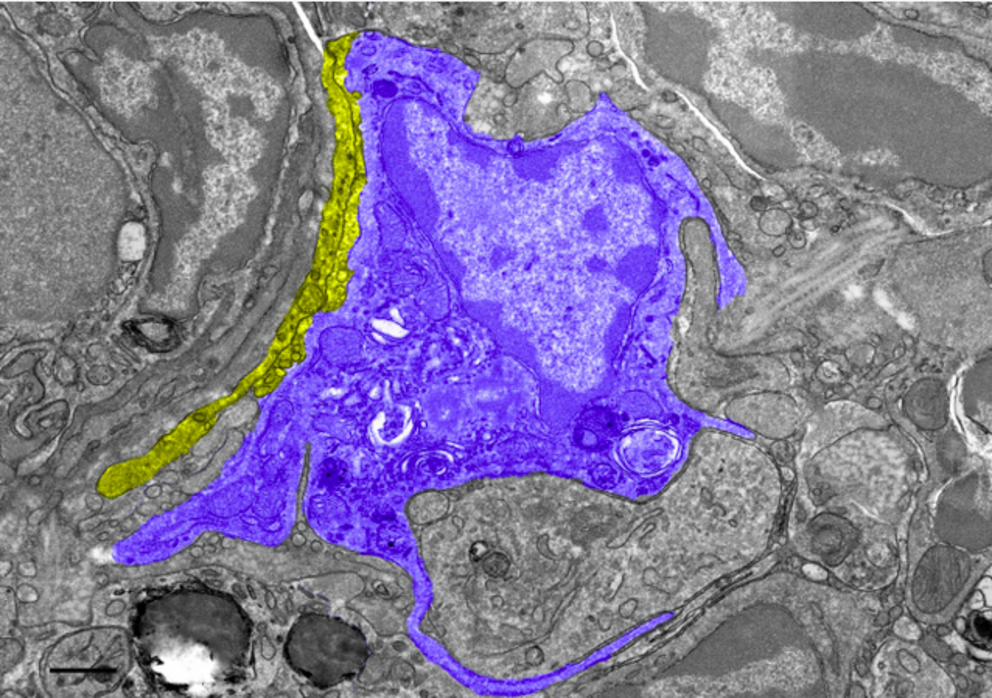
Electron microscopy image of pigeon liver tissue shows hepatic macrophage (blue) in contact with nerve fiber (yellow), which enables them to transmit (“magnetic”) information to the pigeon brain. Image: Lisowski et al. (2026) Science.
To understand how these particles help the pigeons navigate, Lisowski and her team tracked down where magnetic cells are in pigeons’ bodies. Because the liver and spleen store significant quantities of iron, researchers thought these might be good candidate organs. The liver had a significantly stronger magnetic response than any of the other tissues in the study, according to study co-author Ulf Wiedwald, an expert in nanoscience at the University of Duisburg-Essen in Germany,
From there they homed in on macrophages, and put these important immune cells to the test. They studied pigeons that were trained to fly back to their aviary in Konstanz, Germany, from over 12.4 miles away. Pigeons whose macrophages had been removed got lost when the weather was overcast. But when the sun was out, the pigeons reached the aviary, probably with the aid of solar cues.
The findings show how the birds employ magnetic sensing to find their way, as well as the sun’s orientation.
“Our study has implications for both the immune research landscape as well as for research on animal navigation or magnetoreception, respectively. For animal navigation it’s a new concept of how animals sense/perceive Earth’s magnetic field,” Lisowski says. “We think that this ferrimagnetic mechanism can actually explain how birds migrating at night, or sharks or bats or other animals migrating in dark environments can perceive Earth´s magnetic field.”
The team also found that the iron-rich macrophages are close to nerve fibers, indicating that magnetic information can get to the brain via this route. Ultimately, this shows how important interdisciplinary research, involving immunologists, behavioral biologists, and physicists, carries significance for more than just birds.
As for the immune system, Lisowski explains that to accomplish its different fuctions—such as defending our bodies from pathogens and healing wounds—it has to sense the environment.
“Our finding that the immune system can also sense the Earth´s magnetic field is a complete new layer in this concept of ‘immuno-sensation’ and opens the door to new research,” Lisowski explains.