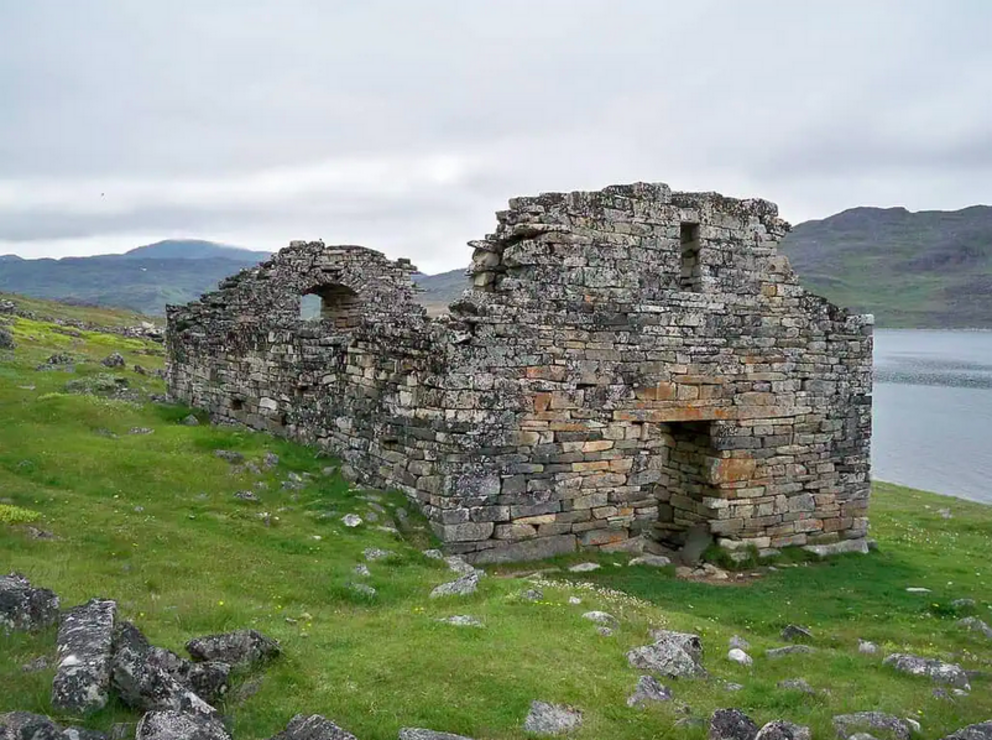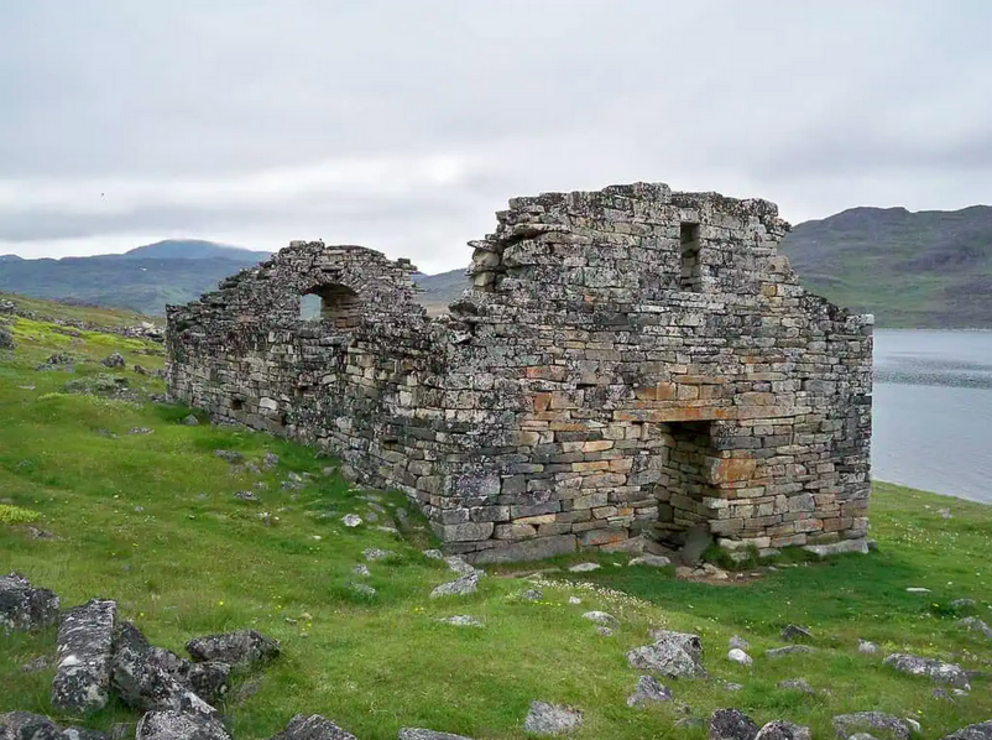
This Milanese friar wrote about North America 150 years before Columbus, and Columbus may have known
It's the first written evidence that proves Columbus wasn't the first European in the Americas.
In 1492, Columbus sailed the ocean blue. But we’ve known for a long time that Columbus wasn’t the first European to set foot on North American shores. The Sagas of Icelanders, backed by hard archaeological evidence at L’Anse aux Meadows, tell us that Vikings journeyed from Scandinavia to Newfoundland via Greenland as early as 999 AD.
The big question has always been: Did the rest of Europe know? Did whispers of these discoveries reach the ears of informed Europeans—possibly even Columbus himself? Thanks to a medieval manuscript and some cutting-edge forensic science, we finally have some answers.
The Friar Who Knew
In a study led by Paolo Chiesa of the University of Milan, researchers documented the first written mention of America in the Mediterranean area. While the initial discovery made waves a few years ago, the full critical edition of the Cronica universalis was officially published in 2024, allowing scholars to fully verify the text’s historical significance.
Penned by the Milanese friar Galvaneus Flamma in 1345, the Cronica contains a stunning reference to a land named “Marckalada,” situated west of Greenland.
This was a strong reference. Chiesa suggests this paints a picture of a world beyond Greenland that was known to the Mediterranean intelligensia a full 150 years before Columbus left Spain.
“Galvaneus’s reference, probably derived by oral sources heard in Genoa, is the first mention of the American continent in the Mediterranean region, and gives evidence of the circulation (out of the Nordic area and 150 years before Columbus) of narratives about lands beyond Greenland,” Chiesa wrote in the study published in the Journal of the Society for the History of Discoveries.
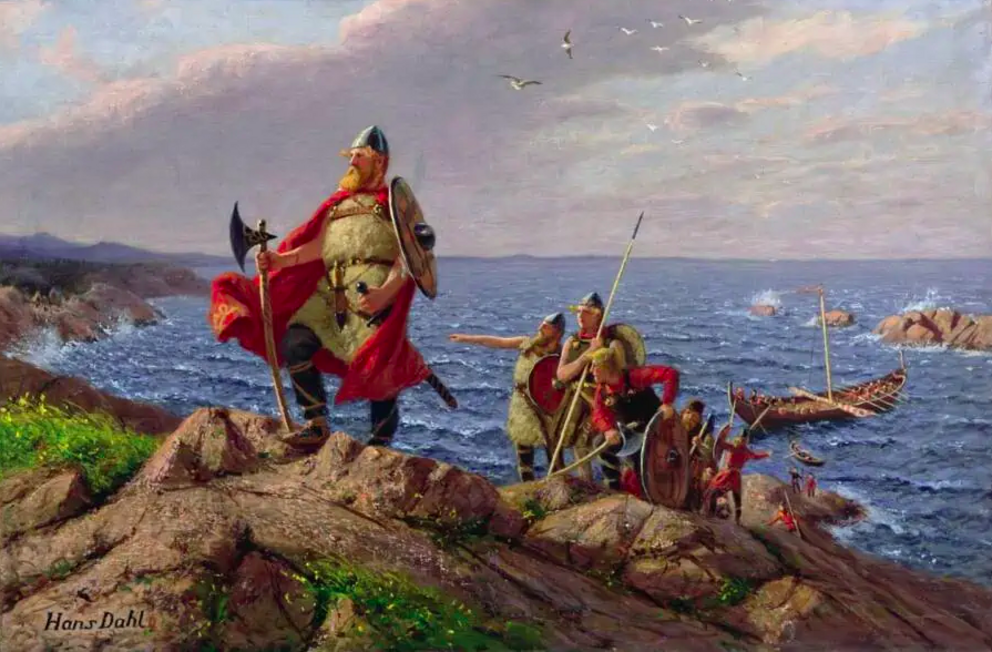 Painting depicting Vikings landing in North America. Credit: Wikimedia Commons.
Giants and Green Trees
The term “Marckalada” refers to Markland, a name given by Icelandic sources to a stretch of North America’s Atlantic coast (likely Labrador or Newfoundland). But is Galvaneus really being serious here?
Galvaneus was a scholar who loved a good story. In his text, he weaves together biblical treatises with accounts from travelers like Marco Polo. But for his description of the north, he relied on the “oral testimony of sailors who traveled the seas of Denmark and Norway.” He claims he was saying absolute truth.
“Further northwards there is the Ocean, a sea with many islands where a great quantity of peregrine falcons and gyrfalcons live. These islands are located so far north that the Polar Star remains behind you, toward the south. Sailors who frequent the seas of Denmark and Norway say that northwards, beyond Norway, there is Iceland; further ahead there is an island named Grolandia, where the Polar Star remains behind you, toward the south. The governor of this island is a bishop.”
“In this land, there is neither wheat nor wine nor fruit; people live on milk, meat, and fish. They dwell in subterranean houses and do not venture to speak loudly or to make any noise, for fear that wild animals hear and devour them. There live huge white bears, which swim in the sea and bring shipwrecked sailors to the shore. There live white falcons capable of great flights, which are sent to the emperor of Katai. Further westwards there is another land, named Marckalada, where giants live. There are also green trees, animals and a great quantity of birds. However, no sailor was ever able to know anything for sure about this land or about its features.”
“From all these facts it is clear that there are settlements at the Arctic pole.”
The mention of “giants” likely refers to Helluland from the Viking sagas. In those legends, the explorer Thorfinn Karlsefni found “slabs of stones so huge that two men could stretch out on them.” As for the giants, they are a staple of Old Norse mythology, likely conflated with the indigenous people the Norse encountered.
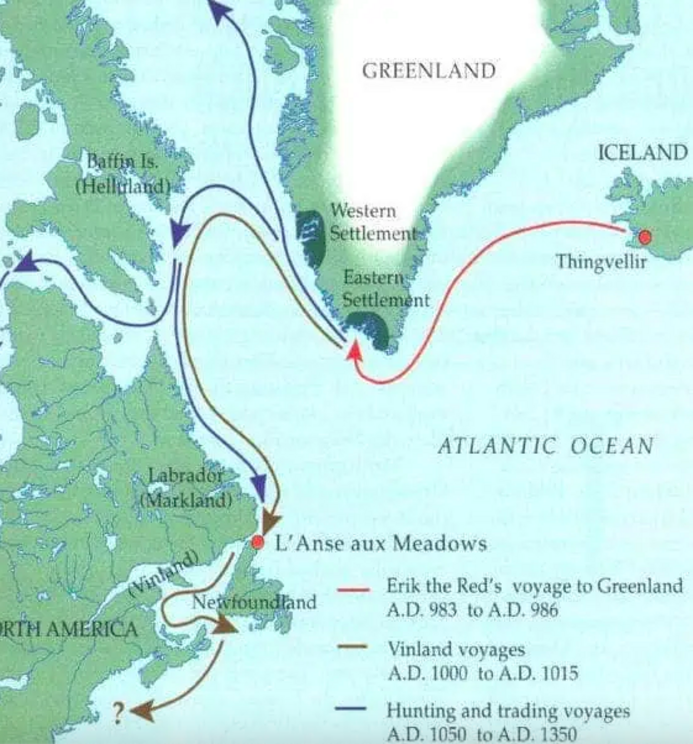 Navigation routes Vikings took to reach Newfoundland.
The “Ivory Engine”
How did a friar in Milan hear sailors’ gossip from the Arctic Circle? Turns out, we now probably know why these rumors were circulating in Italian ports.
Galvaneus studied for his doctorate in Genoa, the closest major port to Milan and a massive hub for maritime trade. A 2024 DNA study of medieval walrus ivory revealed that Norse hunters were venturing far deeper into North American waters than previously thought. They weren’t just exploring; they were supplying the European luxury market.
This lucrative “ivory engine” connected the High Arctic directly to European trade hubs, carrying with it stories of the lands to the west.
Furthermore, a breakthrough 2023 study published in Antiquity analyzed wood from Norse farms in Greenland. They identified timber such as Jack Pine and Hemlock. These species are native to North America but don’t grow in Greenland or Europe, so they must have been brought in.
This confirms that the voyage to “Marckalada” wasn’t a one-off legend. It was a sustained, centuries-long trade route used to harvest the timber needed to build ships and homes.
Did Columbus Know?
The fact that a friar knew about Greenland and Markland in such stunning detail is remarkable. Most 14th-century people in south-central Europe had no idea these places existed.
“Although the papal curia was aware of the existence of Greenland since the eleventh century, Galvaneus is the first to give some information about its features in the Italian area, and, more generally, in a Latin “scientific” and encyclopedic work, as his Cronica universalis claims to be,” the study mentions.
This brings us back to Columbus. As a native of Genoa, could he have been privy to these detailed accounts?
It paints his “foolish” voyage in a new light. Perhaps his audacity wasn’t based on a guess, but on credible sources hinting at a vast, uncharted continent lying in wait to the west—one that his own countrymen had been writing about for over a century. This, however, is less certain now.