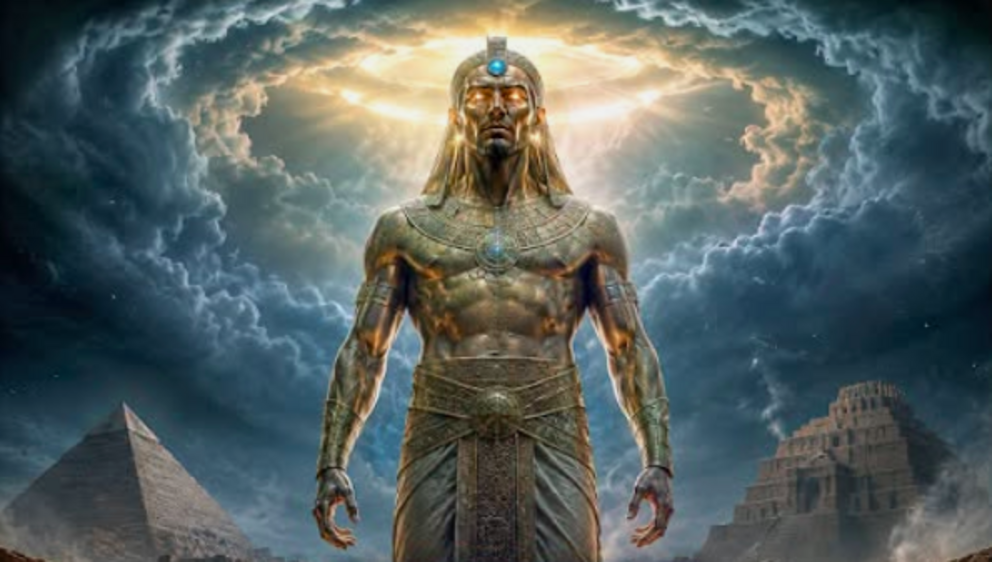
Ancient 'sky Gods': Deities or extraterrestrial visitors?
Across ancient Egypt, China, India, Mesopotamia, and Australia, traditional accounts describe powerful beings associated with the sky, radiant celestial objects, flying vehicles, advanced knowledge, and mysterious journeys between Earth and the heavens. Were these stories symbolic religious narratives, distorted memories of forgotten technology, or evidence that humanity encountered nonhuman visitors in the distant past?
The answer remains unresolved, but the recurring patterns continue to fuel one of the most controversial questions in alternative archaeology.
CASE FILE:
Date: Ancient periods spanning multiple civilizations
Time: Not given
Location: Egypt, China, India, Mesopotamia, and Australia
Setting: Sacred texts, oral traditions, mythology, archaeological sites, and Indigenous rock art
Witness: Not applicable
Reported By: Ancient religious traditions, historical texts, explorers, Indigenous custodians, and modern ancient astronaut researchers
Phenomenon: Sky gods, celestial beings, flying vehicles, culture bringers, divine technology, and possible ancient extraterrestrial contact
Environmental Conditions: Not applicable
WITNESS REPORT / HISTORICAL ACCOUNT
The Ancient Astronaut Question
The ancient astronaut hypothesis proposes that intelligent extraterrestrial beings visited Earth thousands of years ago and interacted with early humanity. According to proponents, these visitors may have influenced religion, architecture, astronomy, technology, agriculture, medicine, and the development of early civilizations.
Supporters frequently point to descriptions of gods descending from the sky, radiant vehicles, heavenly boats, fiery chariots, beings born through unusual celestial events, and rulers who eventually returned to the stars.
Mainstream archaeologists and historians generally interpret these accounts as mythology, theology, political symbolism, or poetic descriptions of natural phenomena. No artifact has been conclusively demonstrated to be of extraterrestrial manufacture.
Nevertheless, the similarities found in traditions separated by vast distances and long periods of time remain compelling. Who were these heavenly beings? What did they represent to the people who worshipped them? Could some ancient gods have been misunderstood visitors from elsewhere?
Ra: The Eye of the Sun
Ra, also written as Re, became one of the most important deities in ancient Egyptian religion. He was closely associated with the sun, creation, kingship, life, death, and rebirth.
In Heliopolitan theology, Ra became closely connected with the creator god Atum. Some traditions held that humanity emerged from Ra’s tears, while Egyptian kings were portrayed as descendants or earthly representatives of the solar deity.
Each day, Ra was believed to travel across the sky in a sacred solar barque. During the night, he entered the Duat, the Egyptian underworld, where he passed through a succession of dangerous regions and confronted the serpent Apep, an embodiment of chaos.
The sky goddess Nut was sometimes depicted swallowing the sun at sunset and giving birth to it again at dawn. This eternal cycle represented death, renewal, and the preservation of cosmic order.
Ra traveled with divine companions who protected the solar barque during its nighttime passage. These figures included deities such as Thoth, Ma’at, Horus, Hathor, and Khepri. The daytime vessel was commonly called the Mandjet, while the nighttime vessel was known as the Mesektet.
During the New Kingdom, the Theban god Amun was combined with Ra to form Amun-Ra. Centuries later, Pharaoh Akhenaten elevated the Aten, represented by the visible solar disk, above Egypt’s traditional pantheon. After Akhenaten’s death, the older religious institutions and solar traditions were restored.
Alternative researchers have interpreted Egypt’s solar disks, heavenly boats, divine lights, and accounts of gods descending during the primordial era as possible descriptions of advanced vehicles or nonhuman visitors.
The Egyptian concept commonly translated as Zep Tepi, or the First Occasion, referred to the primordial period when creation and divine order were established. Ancient astronaut theorists have reinterpreted this sacred period as an era when technologically advanced beings arrived and established civilization.
Traditional Egyptology does not support that interpretation. The solar barque is generally understood as a religious and cosmological symbol rather than a mechanical spacecraft.
Even so, the imagery remains powerful. A luminous being crosses the heavens, enters another realm, battles hostile entities, and emerges again with the rising sun. To modern readers, it is understandable that this journey can sound less like theology and more like an account of travel between worlds.
Huangdi: The Yellow Emperor and Son of Heaven
Huangdi, commonly known as the Yellow Emperor, is one of the central cultural heroes of Chinese tradition. Traditional chronologies place him in the third millennium BCE, although historians continue to debate whether he originated as a historical ruler, a composite ancestral figure, a deity, or a mythological symbol of kingship.
Huangdi is credited with helping establish Chinese civilization. Later traditions attribute medicine, astronomy, calendars, statecraft, transportation, weaponry, music, and numerous mechanical inventions to him or to members of his court.
His principal wife, Leizu, is traditionally credited with introducing sericulture and the production of silk.
Accounts of Huangdi’s birth contain celestial imagery. In some versions, his mother conceived him after encountering a brilliant light or lightning associated with the Big Dipper. Such radiant conception stories have become important to researchers who compare accounts of divine births across different cultures.
Huangdi was also connected with dragons, heavenly omens, immortality, and the Xuanyuan region of the sky. According to one tradition, he eventually ascended to heaven aboard or astride a dragon.
To a traditional reader, the dragon represents sovereignty, divine authority, transformation, and celestial power. To an ancient astronaut theorist, the dragon may represent a misunderstood aerial vehicle.
Huangdi was also credited in later legend with using a south-pointing chariot during a battle obscured by fog. The device has sometimes been described as an ancient navigational mechanism, although the earliest historically documented versions appeared much later than Huangdi’s traditional reign.
Another legend concerns a great ceremonial tripod or ding associated with Huangdi’s ascent. Some modern writers have interpreted descriptions of its strange sounds, energies, and celestial orientation as evidence of a technological device. Traditional scholarship views the tripod as a ritual vessel and symbol of political authority.
Huangdi was also connected with Bai Ze, a supernatural creature said to possess knowledge of spirits, monsters, shapeshifters, and other nonhuman beings. A legendary catalog known as the Bai Ze Tu reportedly recorded information about thousands of supernatural entities, although the original work has not survived intact.
The Yellow Emperor’s story combines royal ancestry, celestial conception, advanced knowledge, strange creatures, mechanical inventions, and a final ascent into the heavens. Whether these elements represent theology, political mythmaking, cultural memory, or something more literal remains open to interpretation.
Krishna: Divine Teacher and Celestial Warrior
Krishna is one of the most revered figures in Hindu tradition. He is commonly regarded as an avatar of Vishnu, although several devotional traditions worship him as the Supreme Being.
His story appears in the Mahabharata, the Bhagavad Gita, the Bhagavata Purana, and numerous other sacred and literary traditions.
Krishna was born to Devaki and Vasudeva after Devaki’s brother, the tyrant Kamsa, learned that one of her children would be the one to cause his death. Kamsa imprisoned the couple and killed several of their children.
Krishna survived after Vasudeva carried him away and placed him in the care of Nanda and Yashoda. He grew up among cowherds, where he became known for his childhood adventures, divine miracles, flute-playing, and his relationship with Radha and the gopis.
As an adult, Krishna defeated Kamsa and became a central figure in the political and spiritual events surrounding the Kurukshetra War. In the Bhagavad Gita, he revealed his cosmic form to Arjuna and delivered teachings concerning duty, devotion, action, knowledge, and the nature of reality.
The ancient astronaut connection is most frequently drawn from descriptions of devas, divine weapons, celestial chariots, aerial palaces, and vimanas.
The Sanskrit word vimana has been used in different contexts. Depending on the text and translation, it may refer to a palace, a celestial vehicle, a chariot, an elevated structure, or a conveyance associated with gods and kings.
In the Ramayana, the Pushpaka Vimana transported Ravana and later Rama through the sky. Some translations describe it as an aerial chariot capable of traveling at the occupant's will.
Ancient astronaut theorists interpret the Pushpaka as a mechanical aircraft. Traditional scholars generally understand it as a miraculous divine vehicle within an epic narrative.
Krishna’s story also includes the attack on Dvaraka by King Shalva, who traveled in a mysterious structure known as the Saubha. The Saubha moved unpredictably through the sky, appeared and disappeared, and attacked the city from above.
Krishna eventually destroyed it.
Modern readers have compared the Saubha to a flying fortress, an advanced military aircraft, or a spacecraft employing camouflage or dimensional technology. Within the religious text, however, it functions as a supernatural weapon granted through divine power.
Dvaraka itself occupies a fascinating position between mythology and archaeology. Hindu tradition describes it as Krishna’s magnificent fortified city on India’s western coast. After Krishna’s departure from the world, the city was said to have been consumed by the sea.
Archaeological and underwater investigations around modern Dwarka and Bet Dwarka have uncovered evidence of ancient settlements, maritime trade, anchors, walls, pottery, and long-term coastal habitation. These discoveries demonstrate that the region possessed substantial ancient maritime activity.
They do not conclusively establish that every description in the Mahabharata is literal, nor do they demonstrate extraterrestrial involvement.
Krishna’s earthly life ended after a hunter mistook part of his body for a deer and struck him with an arrow. Krishna forgave the hunter and departed from the mortal world. Afterward, Dvaraka was overtaken by the sea.
The combination of divine beings, aerial vehicles, devastating weapons, cosmic revelations, and a submerged city has made Krishna’s world one of the most frequently examined traditions in ancient astronaut research.
Anu: Lord of the Great Above
An, known as Anu in Akkadian tradition, was the ancient Mesopotamian personification of the sky and one of the highest divine authorities in the region’s religious traditions.
He was associated with heaven, divine kingship, cosmic authority, and the ancestry of the gods. His principal cult connections included Uruk, one of the oldest major urban centers in Mesopotamia.
Anu was frequently placed at the head of divine genealogies. The Anunnaki were a group of Mesopotamian deities whose name was connected with An or Anu. Surviving cuneiform sources do not identify the Anunnaki as extraterrestrial beings from another planet.
That interpretation became popular through modern alternative writers, most notably Zecharia Sitchin.
Sitchin proposed that the Anunnaki came from a planet called Nibiru and arrived on Earth hundreds of thousands of years ago to obtain gold. According to his interpretation, these visitors genetically altered early humans and created a labor force.
Assyriologists and specialists in cuneiform languages have not accepted Sitchin’s translations. In Mesopotamian astronomy, the term Nibiru could refer to a crossing point or to a celestial body, with its identification varying by text. It was not consistently described as the home planet of the Anunnaki.
Anu was traditionally represented through symbols of divine authority, including the horned crown. His power was primarily religious, judicial, and cosmological.
Some modern retellings attribute laser-like weapons, dimensional portals, force fields, and advanced energy technology to Anu. These descriptions are not part of the standard surviving Mesopotamian accounts and appear to reflect modern fictional or speculative embellishment.
A story involving Anu’s overthrow and castration does exist in the Hurrian Kumarbi cycle. In that tradition, Kumarbi attacks the former sky ruler Anu. This account should not be confused with claims that the Sumerian god Enlil overthrew and castrated Anu.
The distinction is important because Mesopotamian, Hurrian, Babylonian, Canaanite, and later classical mythologies frequently influenced one another. Over time, names, genealogies, conflicts, and divine roles were combined or altered.
From a Fortean perspective, Anu remains significant because he embodies a recurring archetype: a remote sky ruler who grants authority, sends messages from heaven, controls divine order, and stands at the beginning of a powerful nonhuman lineage.
Whether that archetype originated in observations of celestial phenomena, religious symbolism, memories of ancient rulers, or contact with an unknown intelligence remains unanswered.
The Wandjina: Cloud and Rain Spirits of the Kimberley
In 1838, explorer George Grey recorded extraordinary rock paintings during an expedition through the Kimberley region of Western Australia. He described large humanlike figures with prominent eyes, unusual head coverings, and elaborately painted forms.
To European observers, the figures appeared mysterious and unfamiliar. Some later writers compared them to helmeted astronauts or beings wearing protective suits.
The figures are associated with the Wanjina, also spelled Wandjina or Wondjina, sacred beings within the traditions of the Worrorra, Ngarinyin, and Wunambal peoples of northwestern Australia.
The Wanjina are connected with clouds, rain, lightning, fertility, law, creation, and the continuing spiritual life of the landscape. They are not simply characters from a vanished mythology. They remain part of a living cultural and religious tradition.
Wanjina images commonly possess large heads, prominent dark eyes, pale faces, and no visible mouths. Radiating lines around the head may represent lightning, clouds, hair, feathers, or spiritual energy.
According to traditional explanations, some Wanjina lack mouths because their power is so great that speech is unnecessary. Another explanation states that if they possessed mouths, the rain might never stop.
The beings are closely tied to particular locations, clans, water sources, and sacred responsibilities. Their images have traditionally been maintained or repainted by authorized custodians to preserve their spiritual presence and relationship with the land.
The distinctive Wanjina painting tradition is generally estimated to have emerged several thousand years ago, although the wider rock art traditions of Australia are considerably older.
Ancient astronaut writers focus on the beings’ large eyes, pale faces, rounded heads, and radiating halos. These features are compared with those of helmets, breathing apparatuses, electromagnetic fields, and protective suits.
The resemblance can be striking to modern viewers. However, visual similarity alone does not establish extraterrestrial contact.
The traditional custodians of the images identify the Wanjina within an Indigenous spiritual and cultural framework. Any alternative interpretation should acknowledge the living context rather than replacing it.
Some popular ancient astronaut accounts have circulated stories of light-skinned beings arriving inside a red egg or celestial craft and becoming the ancestors of Indigenous Australians. The provenance of these accounts is uncertain, and some contain obvious colonial assumptions.
Such stories should not be presented as authentic Indigenous tradition without reliable documentation from the communities involved.
Australia’s Aboriginal peoples developed sophisticated knowledge of astronomy, seasonal cycles, navigation, ecology, and the movements of celestial objects. This knowledge does not require extraterrestrial intervention to explain it.
At the same time, Indigenous traditions involving sky beings, celestial journeys, radiant objects, spirit lights, and beings descending from above remain important areas of comparative study.
COMMENTARY
These traditions originated in different languages, cultures, landscapes, and historical periods. They should not be treated as interchangeable versions of a single event.
Nevertheless, several recurring elements are present:
Powerful beings descend from or inhabit the sky. Culture heroes provide humanity with medicine, agriculture, law, navigation, architecture, and spiritual knowledge. Divine rulers experience unusual births associated with light, stars, thunder, or celestial signs. Gods travel in boats, chariots, dragons, mobile palaces, or other vehicles capable of crossing the sky. Several figures eventually ascend or return to a heavenly realm.
These patterns may reflect humanity’s universal fascination with the sun, stars, storms, death, kingship, and the unknown. They may also represent political narratives designed to establish divine authority for rulers and dynasties.
Descriptions of flying vehicles may be symbolic, poetic, supernatural, or metaphorical. Ancient authors did not write technical manuals in modern scientific language, and translations can change significantly depending on the translator’s assumptions.
Archaeological discoveries can verify that a city, people, religious practice, or artistic tradition existed. They do not automatically prove that every mythological event associated with that culture occurred literally.
The existence of ancient Dwarka settlements, for example, does not establish that the Saubha was a spacecraft. Egyptian solar boats do not prove that Ra was an extraterrestrial pilot. Mesopotamian references to the Anunnaki do not demonstrate that they came from Nibiru.
Conversely, mythology should not be dismissed as meaningless fiction. Oral traditions and sacred narratives can preserve memories of migrations, floods, droughts, astronomical events, warfare, environmental disasters, and encounters with unfamiliar peoples.
The strongest investigation will neither accept every extraordinary interpretation nor dismiss every anomaly. Each claim must be examined through original texts, archaeology, linguistics, cultural context, and the testimony of living custodians.
The ancient astronaut hypothesis remains unproven. The repeated appearance of sky beings, celestial teachers, radiant births, aerial vehicles, and heavenly departures, however, ensures that the question will continue to be asked.
CASE NOTES
• The source material covers five major cultural regions separated by substantial geographic and chronological distances.
• Sky beings, culture bringers, divine kingship, celestial vehicles, and heavenly ascents appear repeatedly.
• Similar imagery does not necessarily indicate a shared historical event or extraterrestrial origin.
• Translation choices can cause words such as chariot, palace, boat, cloud, dragon, or spirit to sound technological to modern readers.
• Archaeological confirmation of an ancient settlement does not automatically confirm every supernatural event associated with that location.
• Modern claims concerning Anu’s lasers, portals, and force fields are not supported by standard Mesopotamian source material.
• The Anunnaki are identified as Mesopotamian deities in surviving texts, not as extraterrestrial gold miners.
• Wanjina images must be examined within the living traditions of their Indigenous custodians.
• Claims involving light-skinned colonizers or non-Indigenous creators of Aboriginal culture should be treated with extreme caution.
• The most credible approach compares mythology, archaeology, astronomy, linguistics, environmental history, and cultural tradition without forcing a predetermined conclusion.
Readers interested in ancient astronaut theories, sky gods, celestial vehicles, lost civilizations, submerged cities, the Anunnaki, mysterious rock art, and possible extraterrestrial contact in antiquity can explore additional Phantoms & Monsters reports examining worldwide traditions of nonhuman visitors, divine culture bringers, unexplained technology, and ancient high strangeness. Lon
SOURCE NOTES
The submitted source text presented the ancient astronaut framework and compared traditions involving Ra, Huangdi, Krishna, Anu, and the Wanjina.
The Ra section was corrected to reflect his established associations with the sun, creation, life, rebirth, sacred barques, and the combined deity Amun-Re. Research concerning Nut also indicates that her relationship with the Milky Way is more nuanced than a simple one-to-one identification.
Huangdi is treated in historical scholarship as a legendary culture hero whose traditions evolved over time. Stories concerning his radiant conception, inventions, Bai Ze, dragon ascent, and role as an ancestral ruler appear in later mythological traditions rather than in verified contemporary records from his reign in the third millennium BCE.
Krishna is a central Hindu deity, commonly recognized as an avatar of Vishnu or as the Supreme Being in several traditions. Vimanas occur in Hindu epic literature, while archaeological work around Dwarka and Bet Dwarka has documented ancient coastal settlement and maritime activity without proving extraterrestrial involvement.
Anu was the Mesopotamian personification of the sky and a source of divine and royal authority. The surviving traditions do not describe him using lasers or modern technological portals. The castration story belongs to the Hurrian Kumarbi cycle, in which Kumarbi overthrows Anu.
Wanjina traditions are part of the living cultural framework of the Worrorra, Ngarinyin, and Wunambal peoples. The distinctive figures are associated with clouds, rain, law, creation, and specific sacred locations, and the painting tradition is generally dated to several thousand years ago.
The ancient astronaut hypothesis remains outside accepted archaeological scholarship because no reproducible physical evidence has been found to demonstrate extraterrestrial intervention in ancient human civilization.
FAQ
Does archaeology prove that extraterrestrials visited ancient civilizations?
No verified archaeological artifact has been conclusively demonstrated to have been manufactured by extraterrestrial beings. Ancient astronaut interpretations remain speculative.
Do ancient religious texts describe flying machines?
Some texts describe celestial chariots, flying palaces, heavenly boats, dragons, clouds, and vehicles capable of moving through the sky. Whether these descriptions were intended literally, symbolically, or supernaturally depends on the text and tradition.
Were the Anunnaki aliens from Nibiru?
Surviving Mesopotamian texts describe the Anunnaki as a group of deities connected with An or Anu. The interpretation that they were extraterrestrials from Nibiru originated with modern alternative writers and is not accepted by specialists in cuneiform languages.
Have archaeologists discovered Krishna’s lost city of Dvaraka?
Archaeologists have found evidence of ancient settlements, maritime trade, anchors, and submerged structures around Dwarka and Bet Dwarka. The direct identification of those remains, with every detail of Krishna’s legendary city, is debated.
Are the Wanjina paintings depictions of extraterrestrials?
Ancient astronaut theorists have compared their appearance to helmeted beings. Traditional custodians identify the Wanjina as sacred cloud, rain, law, and creation beings within a living Indigenous cultural tradition.
Why do so many cultures describe beings descending from the sky?
Possible explanations include religious symbolism, observations of celestial phenomena, royal legitimacy, shared psychological archetypes, cultural exchange, memories of unusual natural events, or encounters with unfamiliar peoples. Extraterrestrial contact remains an unverified possibility.